-
-
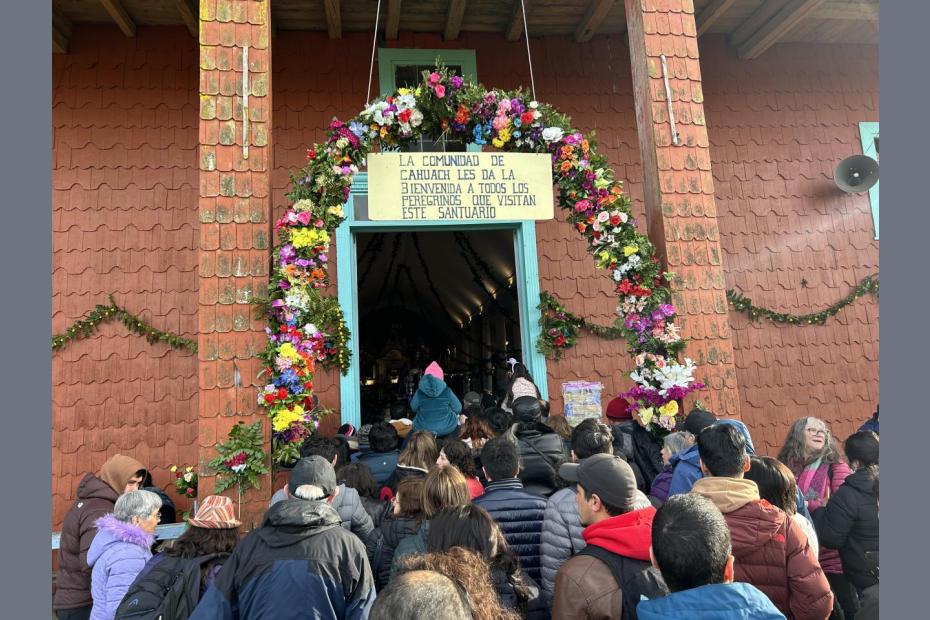
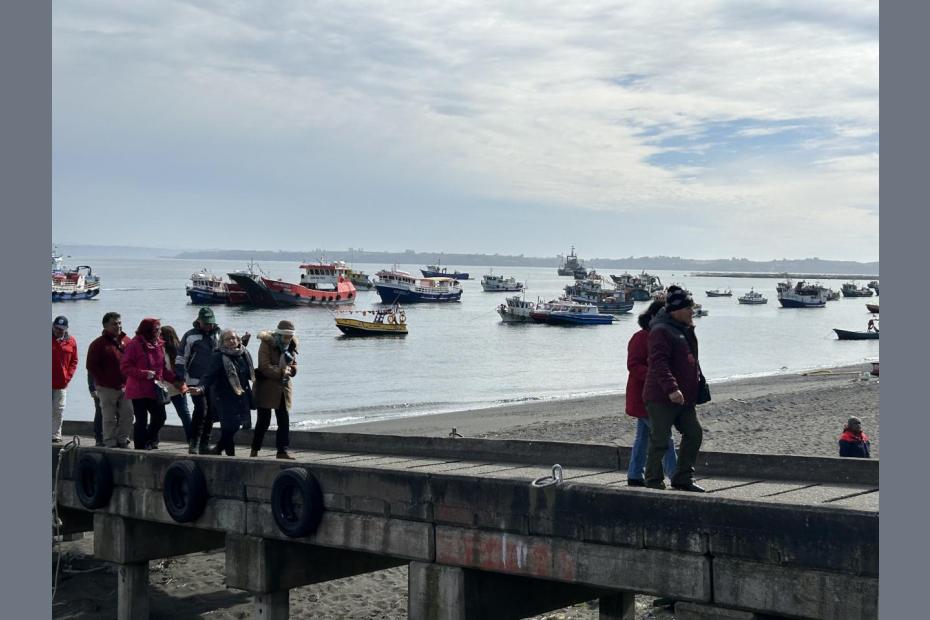 Pilgrims from beyond the five island towns arrive for the feast.
-
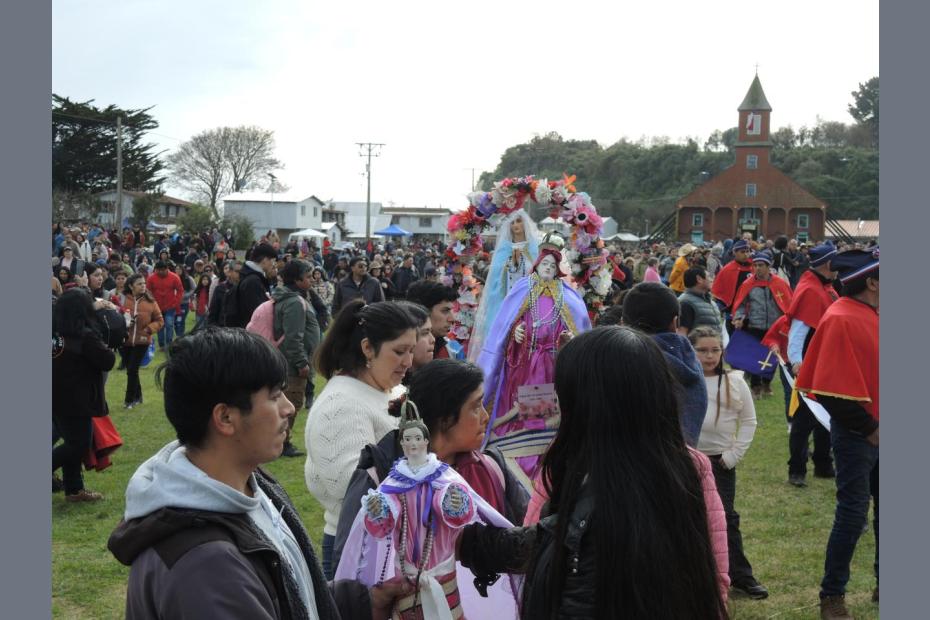 Other religious images are lined up for the procession. The image at the Center is Our Lady of Perpetual Help from
-
-
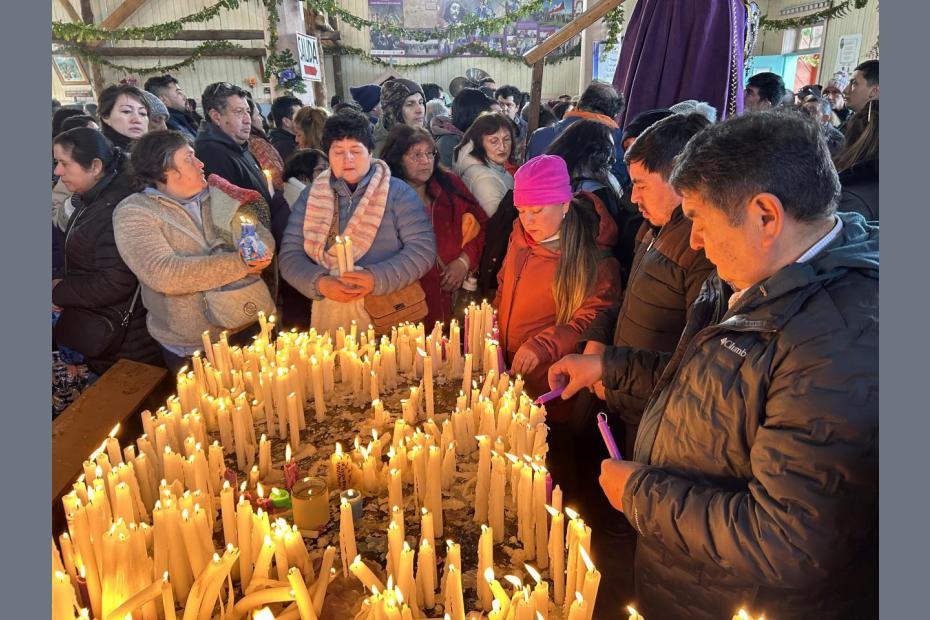
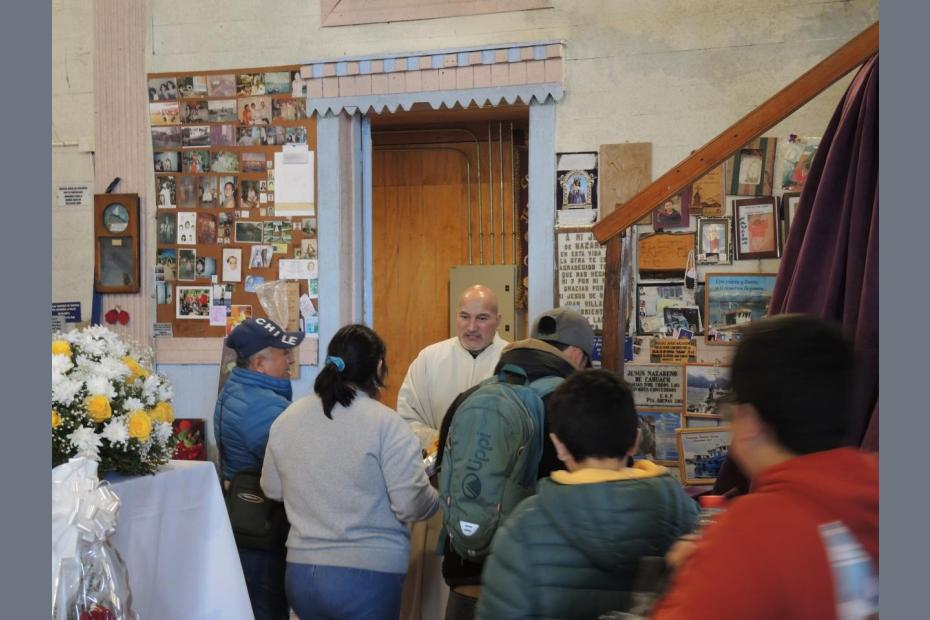 Devotees line up to bring candles, rosaries and other religious items to be blessed.
-
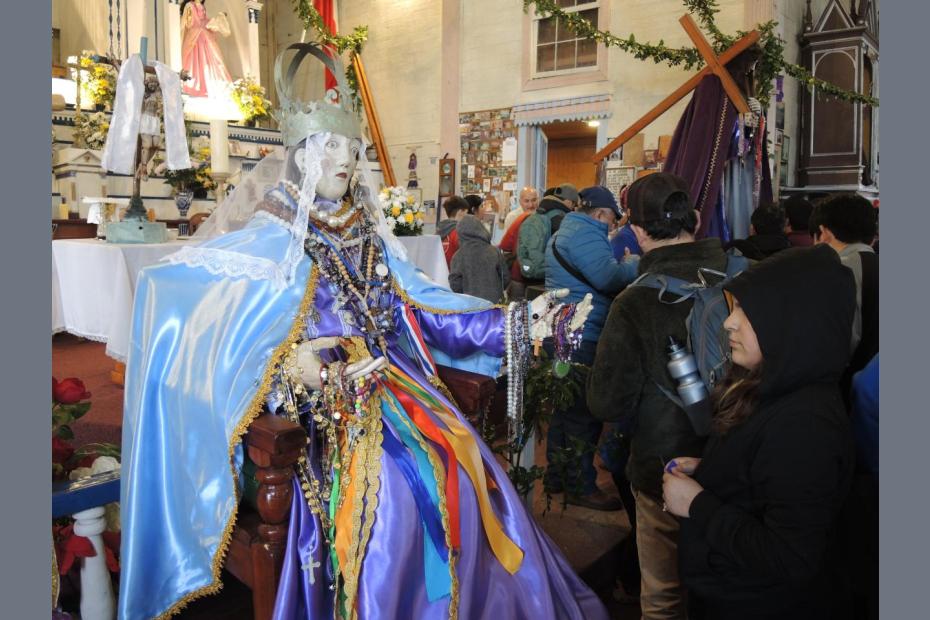 Devotees leave rosaries along the arms and nexck of a large image of the Virgin de Gracia from Tac Island. This young woman also holds a small piece of cloth from the prior year's mantle of the Nazarene, distributed as devotional objects to take home.
-
-
-
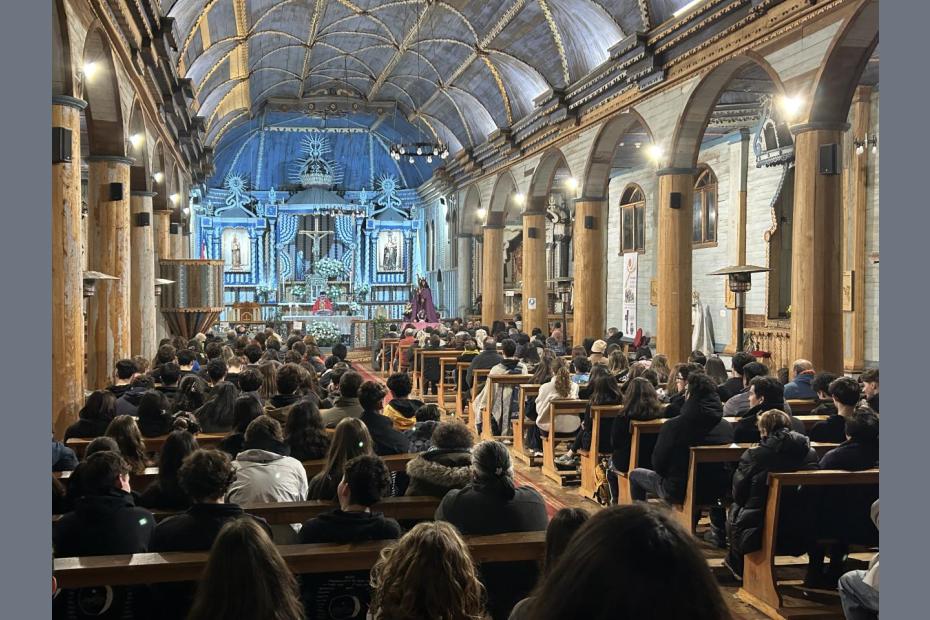
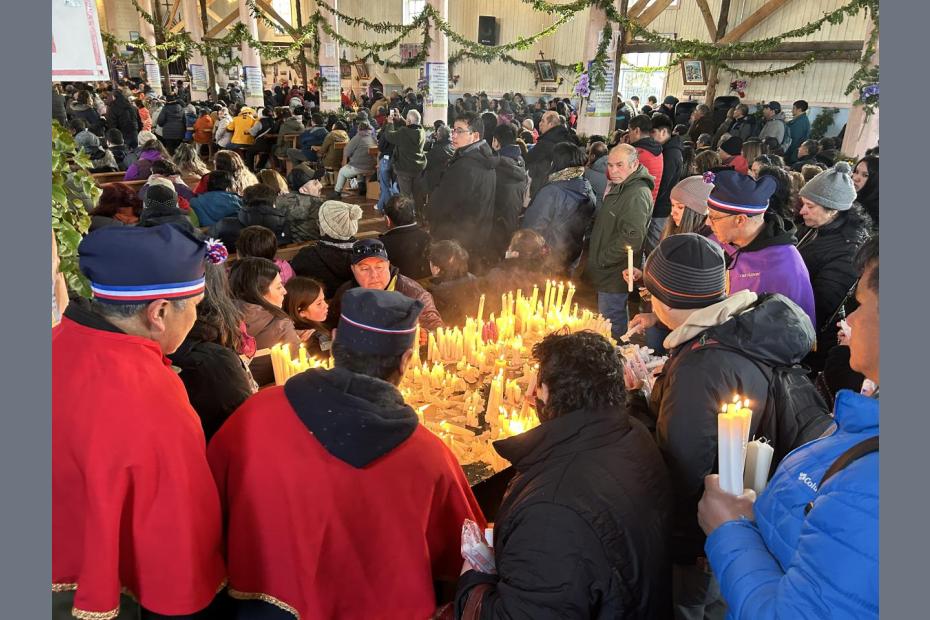 Devotees inside the church. The men in red capes are members of the cabildo, the organizing committee.
-
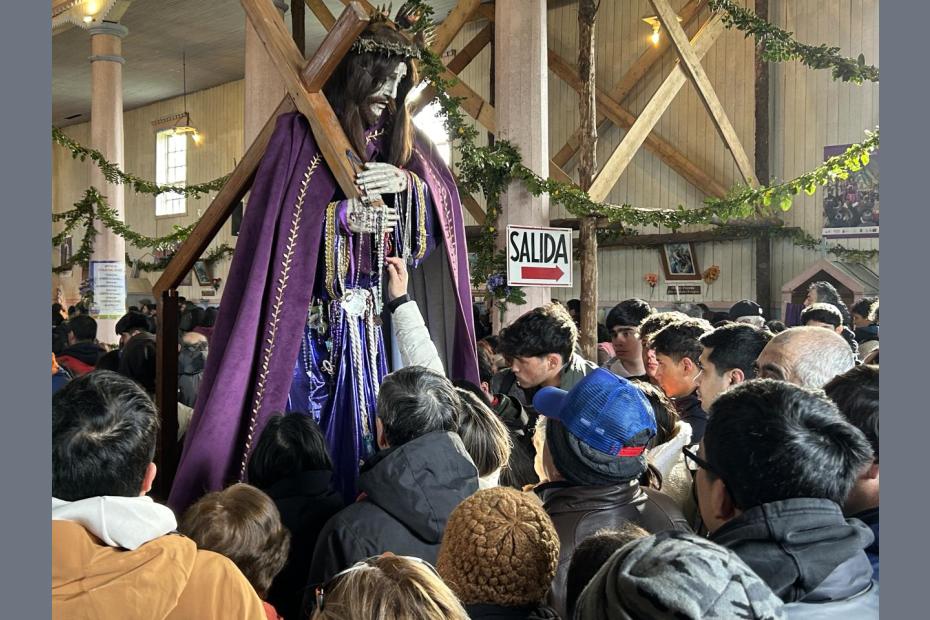
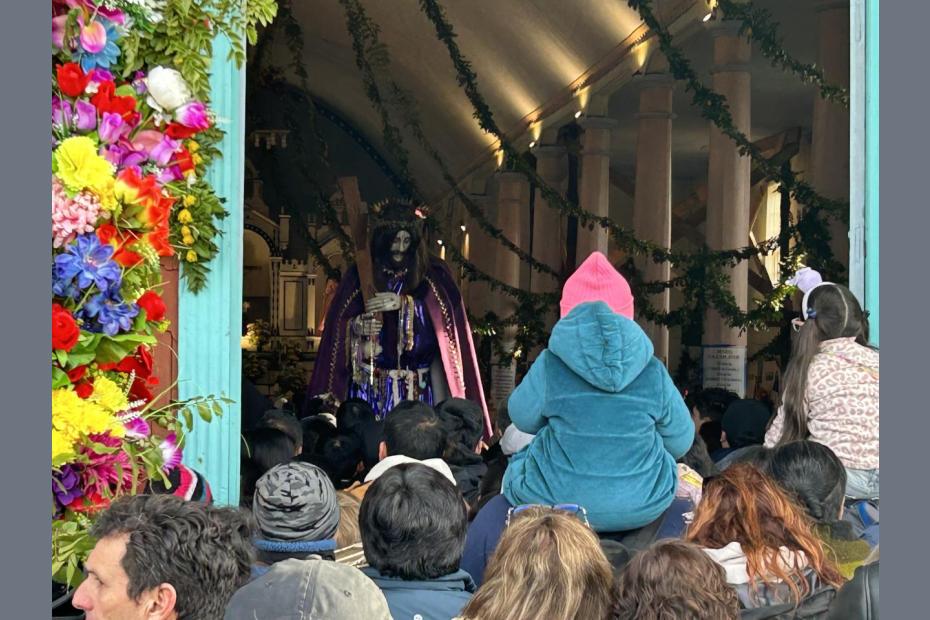
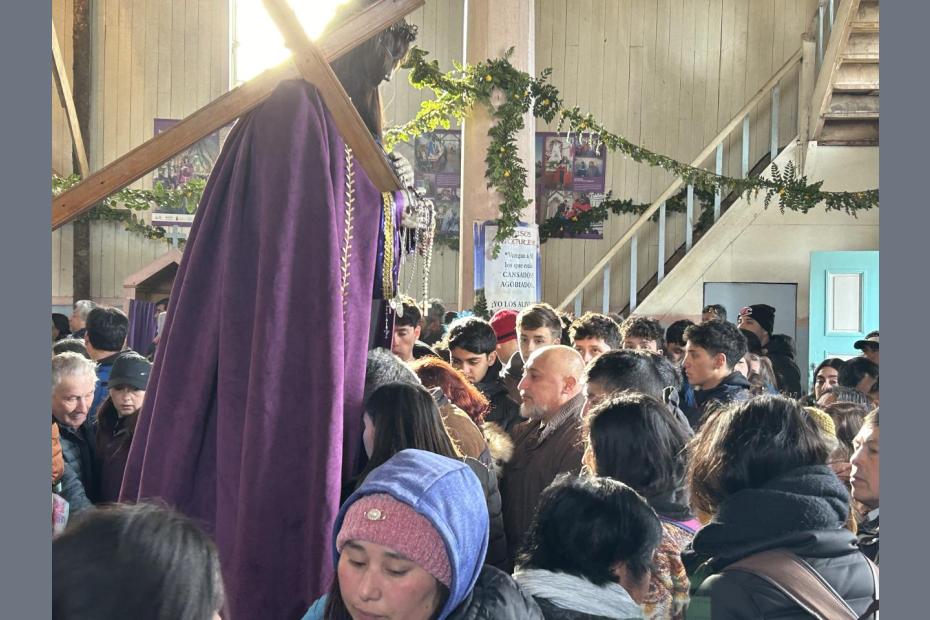
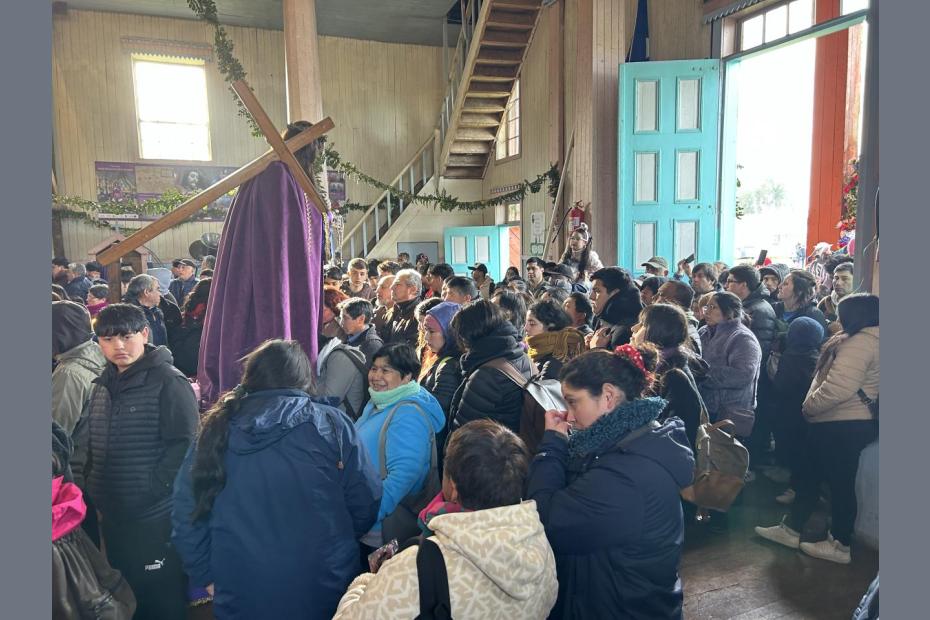 Devotees around the image of the Nazareno, awaiting the procession in the afternoon.
-
-
-
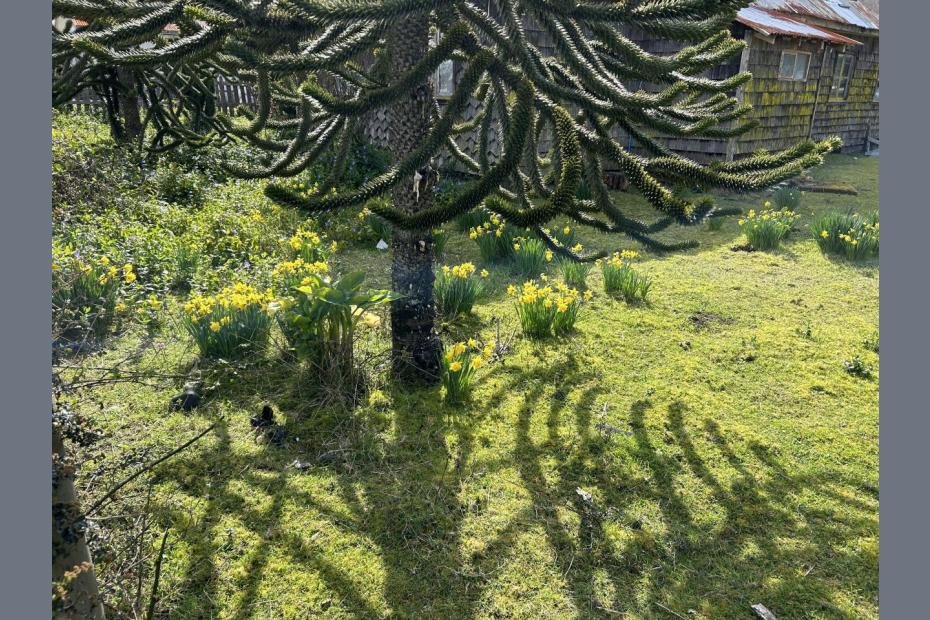 In one sense, the feast of the Nazareno is not in synch with the liturgical year. Interestingly, as these tulips show, it coincides with the arrival of spring, like Holy Week does in the northern hemisphere.
-
-
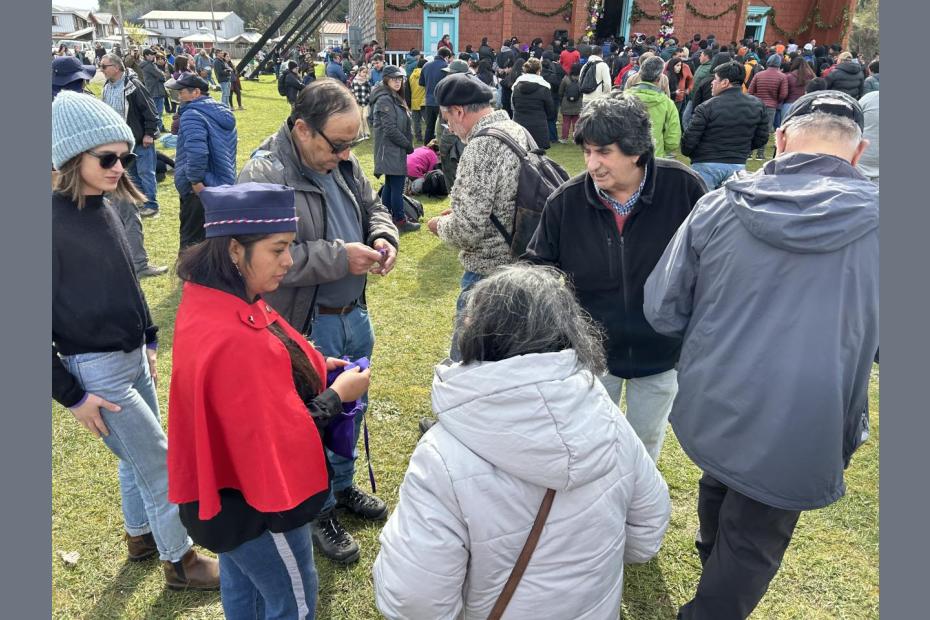 A member of the cabildo, the organizing committee, offering pieces of the mantle that draped the Nazareno the prior year.
-
-
-
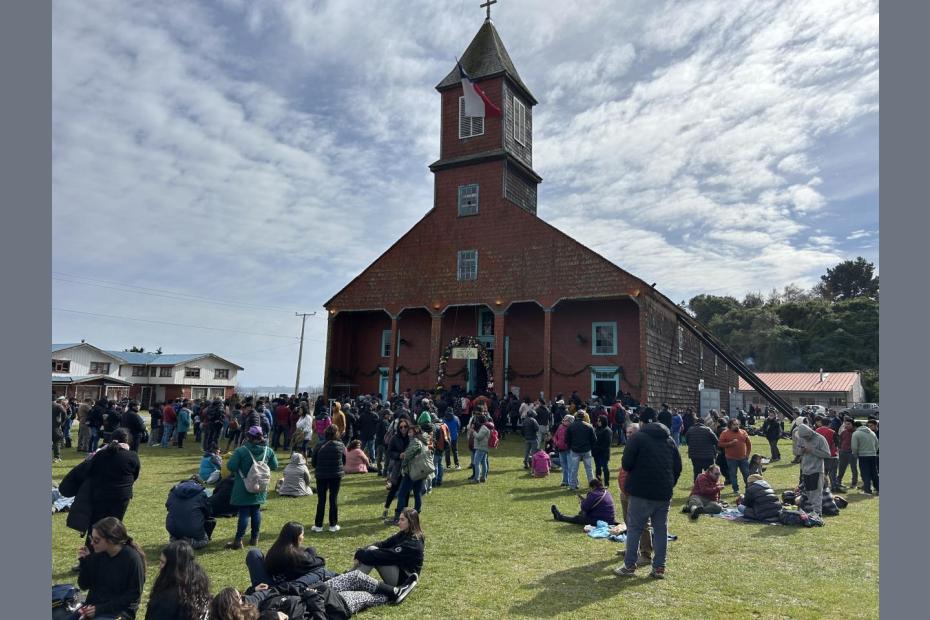
Each year at dawn on August 30, a flotilla of boats from nearby islands crosses the deep, cold waters around southern Chile’s Chiloé archipelago to converge on the island of Caguach (pop. 515) for a feast that Indigenous people of five islands have celebrated for centuries. All of the archipelago’s Catholic churches celebrate their patronal feasts, but the feast in Caguach, celebrated in honor of Jesús Nazareno in one of the large, distinctive wooden churches that serve as the region’s major landmarks, is the most important of them all.1
The Chiloé archipelago, a group of rainy, green, hilly islands that run north-south for almost 200 km along the Pacific Coast, separates the Pacific Ocean from the Sea of Chiloé and the snow-capped mountains that line the mainland just north of Patagonia. Chiloé, ancestral home of the Chono and Huilliche Indigenous peoples, has a distinctive cultural identity, reinforced by its separation from the mainland. Caguach is even further separated geographically. Reaching Caguach from the Chilean mainland requires two ferry crossings, considerable driving, and a one-hour boat ride from the largest nearby town, Achao (pop. 3,500). People on Caguach depend on salmon fisheries, other forms of aquaculture, and small-scale agriculture for most of their livelihood. Aside from the feast, few non-natives have reason to visit.
The feast honoring Jesus of Nazareth, as depicted by a large statue of a sorrowful Jesus weighed down by the cross, is marked in a manner distinctive to Chiloé. Its major events–a boat rowing competition, a novena, arrival ceremonies, flag ceremonies, Masses, and a procession across the long esplanade in front of the church–span ten days, though for most pilgrims, August 30 is the day that counts. The feast is the legacy of a historic missionary strategy and has enduring appeal for reasons of devotion, respect for ancestors, heritage, social engagement, and collective identity.2
By one count, there are 362 Catholic feasts a year in Chiloé, focused on 56 different Catholic devotions: “57% are devoted to the Virgin, 25% to a saint, 16% to Christ and 2% to the Feast of All Souls.”3 By all accounts, though, the Feast of the Nazarene at Caguach, recounted here, is the most important and draws the largest crowd. Interest in the Nazarene devotion is large enough that it is also enacted a second time each year, in January, during the height of summer, when larger numbers of visitors attend from beyond the five island towns that organize the feast, Caguach, Apiao, Alao, Chaulinec, and Tac.
Historical Background
Sustained Catholic evangelization in the Chiloé archipelago began in 1608, when Jesuit missionaries arrived.]4 Given the wide dispersion of the Indigenous population on many islands and the modest number of missionaries, the Jesuits developed a system of “circular missions” that brought them by canoe to each mission station once a year for just a few days. The system grew to encompass 77 communities, ranging in size from a few dozen to 500 people. Whereas the Indigenous communities did not previously have fixed places of worship, or often even fixed places of settlement, the Jesuit system, organized around wooden churches as gathering places, reshaped the islands’ settlement patterns to the present day. The Jesuits' short stays were days of intense religious activity, preaching, sacraments, devotions, and processions.
The rest of the year, the missions were led by fiscales, trained and delegated laymen appointed to lead the Church in each settlement. The fiscal “called the local population to prayer, taught doctrine, baptized, and helped them to die well [praying for them at the end and burying them].”5 The system empowered Indigenous people to be key year-round agents of evangelization. Only members of local Indigenous communities, not people of Spanish heritage, could be fiscales. They were moral leaders in the community, expected to care for it spiritually. Fiscales remain integral to parish life today.
The distinctive, large wooden churches that the local people and the Jesuits built, combining Indigenous wooden boat-building skills with European forms, are another legacy of the circular missions.6 Sixteen of these churches, including the church at Caguach, are recognized as UNESCO World Heritage sites. The churches are products of the Spanish colonial era, but their style is unlike anything else in the Spanish colonial world. The diocese plays an integral role in preserving all 70 of these churches as essential elements of local culture, not only as monuments or museums, but as the heart of living communities.
When the Jesuits were expelled from Spanish territories in 1767, Franciscan priests took over the work, continuing the circular missionary system.7 The Nazareno feast on Caguach traces its origin to the beginning of that era. Popular accounts say that Friar Hilario Martínez, a Franciscan Capuchin, brought the image of the Nazareno to Caguach and enlisted residents of the five islands to compete to host it. The statue has been housed in Caguach in 1778. The other towns received smaller saints’ images.8 Folk traditions say that the decision to house the image on Caguach was conditioned on a promise to organize a yearly festival for the Nazarene.9 The feast’s date may have been chosen to override an Indigenous ritual celebrating the arrival of spring.10
Caguach may have won the image, but the popular story is that the Nazarene united the five islands and brought unity where there had too often been violent competition. Residents of the other four towns helped build the church in Caguach so that it would be large enough for the feast. The Nazarene feast, built around rituals of shared devotion, is the one event that brings together residents of the five islands to live together for a few days and to get to know each other. Competition is not entirely erased: one interviewee recalled that the nights could get interrupted by incidents of “competition” between island men, fueled also by alcohol, but he said that had not happened in the last few years. The preba and the flag ceremony, both described below, are also competitive rituals. Nonetheless, the shared, enduring commitment of five islands residents to unity and shared purpose through the feast should not be underestimated.
At the Feast
Attendance at the feast draws people from a widening and then narrowing group of places: first the devotees from Caguach, then islanders from the other sponsoring towns, then devotees, including many non-Indigenous people, from beyond the five islands. At the close of the feast, that order reverses.
For nine days before the August 30 feast day in 2024, villagers from Caguach gathered daily for novena prayers.
One week before, on August 23, boats from the five islands competed in the opening inter-island event, the preba, a rowing competition that ritually transforms the islands’ historic competition for the Nazareno image into a boat race.11 Teams of sixteen men from each of the five islands raced each other in large rowboats. Before they raced, each team stood with their oars for a blessing by the priest. Rowers often participate in the race as a manda, a type of promise quite common in many parts of the Iberian-influenced world, to row in the preba for the Nazareno a certain number of times. The manda is a way to express devotion to the Nazareno, a physical sign of sacrifice, and, in particular, a way of building an ongoing relationship with him. Mandas are also sometimes made to show thanks, or on behalf of others in need of prayer. At the same time, the race is unabashedly a competition. To win it is an honor for an island.12
Over the next four days, delegations from the other island towns, beginning with Apiao, arrived by boat on successive days singing hymns, playing music, and each carrying their village’s patronal image to the church. The arrivals were sacred events in themselves. Neighboring islanders were welcomed with a liturgical procession, the tolling of the church bell, and rejoicing.13 Their patrons’ images were displayed along the side aisle of the church alongside significant holy images belonging to families in Caguach. These days are for the people of the five island towns. The guests stayed in shelters around the church.
On August 28, the major event was a procession of the Blessed Sacrament to five outdoor altars, one for each town. Then the image of the Nazareno was brought down from above the high altar.
On August 29, another ritual, perhaps odd if seen out of context but integral to the islanders, was the highlight of the day. Two rows of men lined up in red capes, each holding flags representing their island’s patron saint, waving the flags at those carrying different flags in a sort of dance. The ritual’s meaning is obscure–Cárdenas and Trujillo, in their in-depth 1986 study of the feast reported, “The islanders do not give it any meaning other than a “game of flags”–but it is often explained as a ritual reenactment of battles between the towns before they were united by the Nazareno devotion.14 The Mass before the flag ceremony is known as a “liturgy of peace,” and a listing of the week’s events at the church entrance explained it as a commemoration of a peace between the five towns said to have been achieved when the Nazarene statue arrived there centuries ago. The ceremony ended with a procession to the church led by the priest.15
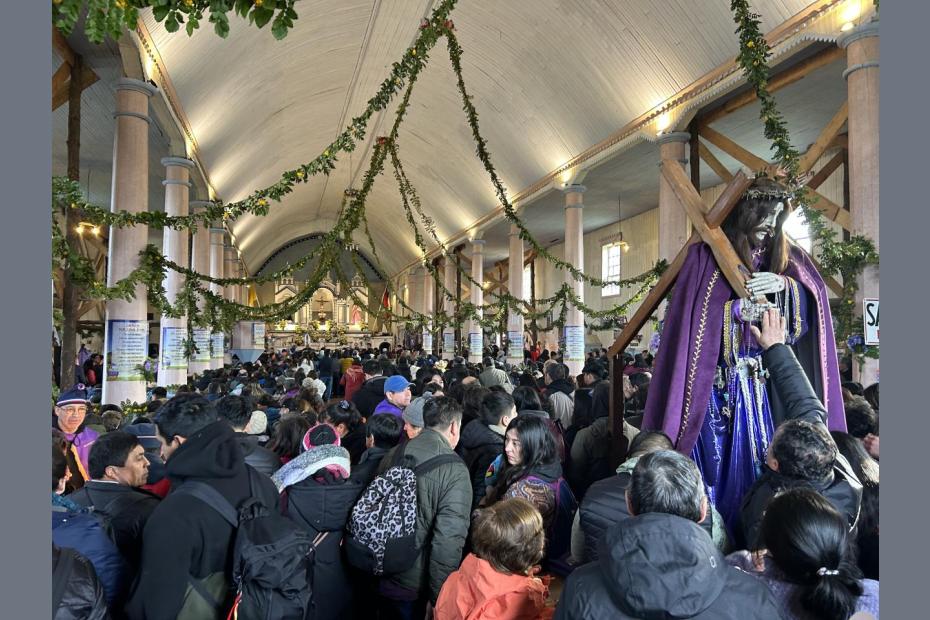
On the morning of the feast, August 30, the image of the Nazarene was brought forward toward the portico to welcome the pilgrims. It is life-sized and similar to the images one sees in Seville [link] today. Jesus, face bloodied and head crowned with a silver crown evoking the Trinity, is bent over by the weight of his cross. He wears a regal purple cloak, which is replaced every year.
Before sunrise, a long line gathered along the pier at Achao, the main city and port on the more populated Quinchao island, to meet up with boats that ferry them on the hour-plus trip to Caguach. Other boats traveled from different ports. After traveling over open seas, it was a sight to see a harbor full of all sorts of boats adapted for pilgrim transport. When pilgrims disembarked at the dock, Caguach’s population grew six- or eight-fold.
While the procession is important and moving to participants, the opportunity to stand before the Nazarene in the morning was the most visibly emotional and intimate religious experience of the day. People waited patiently to approach the statue, almost always just looking at his face. On reaching the image, some placed a small object like a rosary or a baby apron in his hands or his arms. Others touched his hand or simply stood and gazed.
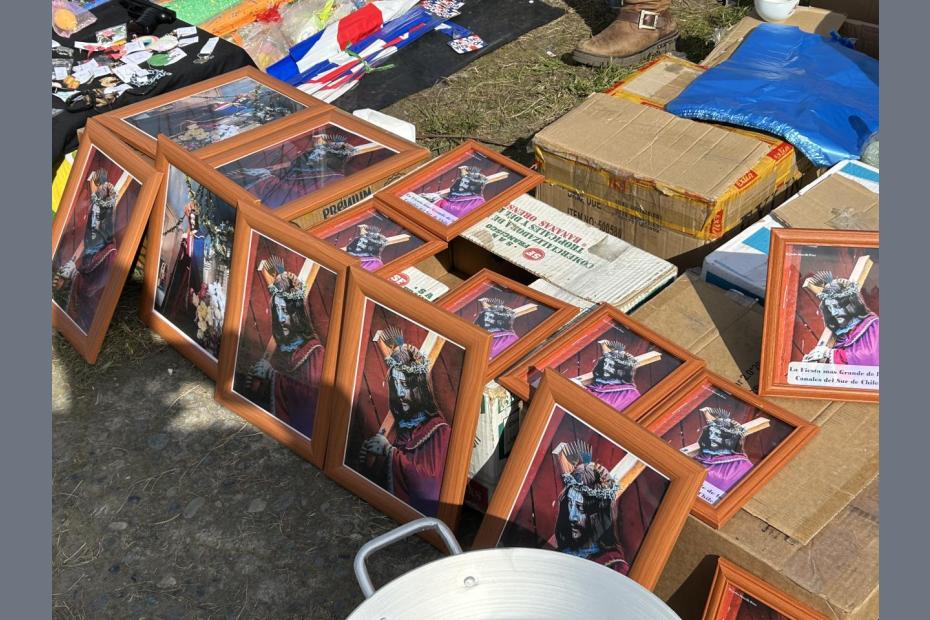
Devotees crowded the rest of the church. A large metal tray was ablaze with candles near the Nazarene’s statue, and people stopped to pray there for a long time. Others visited the tables in the side aisles with other saints' statues, sometimes lighting a candle there. A large, seated image of the Virgin near the altar also drew devotees, but the day was very much about the Nazarene. There were two morning Masses. After Mass, people of all ages lined up to have religious and familial objects blessed and to talk to the priest. On the edges of the esplanade, one could buy many such objects, particularly rosaries and images of the Nazareno.
Devotees’ encounter with the Nazarene often involved both the giving and taking of physical objects. Many people left a small physical object with the Nazarene, and on the esplanade, where a young woman in a red cape was there to distribute them, they asked for a small piece of the purple silken cape that adorned the Nazareno the prior year.
Along the edges of the esplanade, pop-up restaurants inside homes sold lunch before the procession.
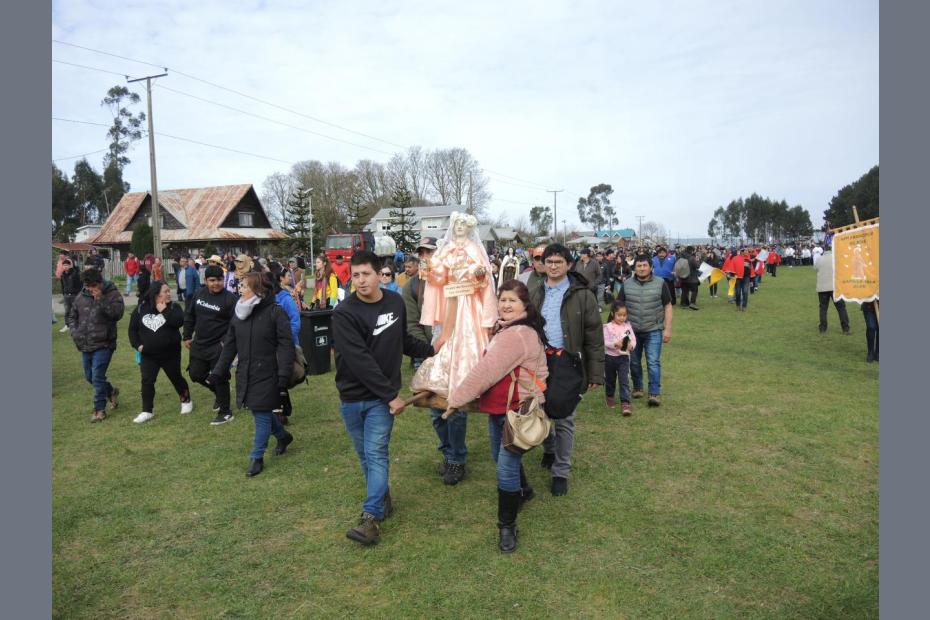
In the afternoon, the procession on the esplanade was the ultimate event of the feast day. The wide, 400-meter-long esplanade in front of the church signals that the physical shape of the town was designed expressly for the procession. The Nazarene and other sacred images were slowly processed to the end and back, surrounded by a large crowd. The procession was led by large Chilean flags and by the priest, the fiscala (see below), and many members of the cabildo, the council responsible for organizing the feast. It was accompanied by a band primarily composed of accordion, drum, and guitar players playing a pasacalle, a musical form typical in Chiloé for processional and devotional use. (A pasacalle was also played during the descent of the Nazarene image from the high altar and to greet and say goodbye to groups from the other four towns.)16 The pasacalle originates in 17th-century Spain, but has taken on a particular vernacular sound with these instruments.17 In few, if any, other parts of the world is that form, or the accordion, integral to worship hymnody.
The procession ended with blessings and common prayer in front of the church.
Following the procession, the visitors who had crowded the church and esplanade waited at the docks to ride home, eventually leaving only the devotees from Caguach and the other four islands. After Mass and two processions around the church the following morning, the residents of Apiao, Alao, Chaulinec, and Tac departed as well.
Unique Organizational Structures
One of the most notable things about the feast and the religious life of Caguach is the long tradition of lay leadership that is fundamental not only to the organization of the feast, but also to the year-round prayer life of the community.
The feasts are enabled by, and continue to reinforce, an Indigenous form of social relationship known as minga, wherein people give voluntary labor to each other for important social tasks.18 Minga labor from the five towns was essential in the construction of the wooden churches, including the church at Caguach, and is essential in the organization and success of the feasts as well.
The cabildo, the feast’s organizing council, is another notable form of leadership organized in its own vernacular form dating from the 18th or 19th century. Cabildo members meet in advance for ritualized planning meetings and dinners that are open to the whole town.19 They volunteer, or as children are volunteered by their parents, often as a manda, whereby they stay in the cabildo for years, and can rise within its highly graduated hierarchy.20 While a priest has a very visible and important role at the Nazareno feast, almost all of the organizational responsibility for the feast belongs to the cabildo. “The Cabildo of Caguach has the following offices: supremo [supreme one (male)], first governor, first mayor, second mayor, first minister, second minister, first corporal, second corporal (also called first assistant and second assistant) and first lieutenant. There is also a suprema [supreme one (female)], first princess and second princess.”21
At the feast, the cabildo members wear bright, silk costumes that seem to derive from archaic military dress, often including capes. The girl known as a princess has a historic, fundamental role, and at the feast joins the procession with a second princess walking under the flower arch. Like many of the functions and the costumes, the girls walking under the arch, the primary students of the feast note, “must express a very complex allegory that has been lost to us today.”22
Since at least 1622, public prayer in Caguach–including on most Sundays–has been led by a fiscal, a lay person designated by the bishop who teaches, catechizes, leads novenas and liturgies of the Word, baptizes, witnesses marriages, and buries the dead. The pastor, who lives off-island and is responsible for many communities, visits occasionally. Caguach’s fiscal from 2010 through the feast in 2024 was, as is the case in several communities nearby, a woman (fiscala), Gloria del Carmen Segovia Levín. The family of a visiting fiscal at the feast explained that the decision to serve in his case was in thanksgiving for the healing of a son who had seizures. Another fiscal described it as a responsibility that has belonged to prior generations in his family. A fiscal from one of the five islands reported how he had taken on the role after the recovery of his child from seizures. His father-in-law was a fiscal, and he was grateful to the Nazarene, so he became one. He described how, having received training and a mandate from the bishop, he conducted baptisms, funerals, and marriages. He spoke about how fiscales must act as moral figures in the community, but noted that he was worried that as he was aging, he could not find anyone who wanted to succeed him.
Like and Unlike, Communal and Personal
The feast’s full ten days, with a novena, procession, and Masses, are in many ways similar to Catholic feasts elsewhere in the Iberian-shaped world, but also different. Elements like the flag ceremony, the preba, and the forms of musical accompaniment are not incidental to the devotion, or elements adapted like some gifts procession in traditional costume that “inculturates” an essentially European-designed liturgical event. Nineteenth-century Church officials tried to “clean up,” or purify, the festival rituals in line with more modern and European sensibilities, but failed.23 One team of authors describes the events other than the Masses as “a popular liturgy of archaic origins.”24 Another group of scholars argues that the rituals at Caguach have affinities with older Huilliche rituals, but don’t make the case that attendees at the feast are conscious of these affinities.25 The pasacalle, while it has Spanish origins, is probably unique to Chiloé for liturgical use.
To what extent the events of the feast carry on Indigenous culture is difficult for scholars and local people to say. But Indigenous people from the islands consistently describe the feast, the church building itself, and the organizational structures that surround it as legacies of their ancestors, hence things to be carried on and protected.
The fact that the feast is on an island, and reachable only by water, changes the feel of this pilgrimage from pilgrimages that involve walking or driving. The experience of being on open water is quite different from walking or driving. For residents of Caguach, the feast is a moment that partially overcomes their insularity and takes them from being peripheral to being the center of attention.
While the Nazarene is undoubtedly the focus of attention, this feast is a bit unusual in that it makes room for many sacred images in supporting roles. The images from other parishes carried by boat and around the plaza in procession “become pilgrims themselves, members and representatives of their community.”26 When traveling by boat to reach neighboring islands’ feasts, the saints, like the people here, become seagoing people. One woman interviewed at the feast summarized it quite literally: the saints, too, she said, “are here on a visit.” The closest parallel to a feast inviting other images into the event is perhaps at the Feast of Señor y Virgen del Milagro in Salta, Argentina, where the pilgrims also carry their own patron images of the Virgin.
The feast is like many other Catholic rituals and events in that a great deal of its power derives from the ability of the devotion and ritual to unite people. At the same time, it is probably unique in the Catholic world insofar as it also ritualizes competition–sacralizes it–for the sake of recalling historic events that make it sacred to the Indigenous people at the center of the event, making the ritual a way of recalling the actions of their ancestors.
Interviews among attendees, many of them from the five islands, uncovered a paradox when people spoke about why they came. So much about the pilgrimage is communal. Some spoke of it as an inheritance and something that “our people” do, and said that the fact that it has been done every year for so long makes it meaningful to them. One woman who attended for the first time reported how moving it was to join in the devotion of the people. Yet almost as often, interviewees spoke of their devotion in individual terms, and offered very personal reasons for coming.
It helps me, one woman said, “to break out of a routine faith.” A man from Apiao reported that, like everyone from the island, he had been part of the tradition since childhood. His wife, he said, was particularly devoted, but because of her severe depression, could not come. He had come alone and was praying for his wife, hoping that being here could help cure what medicine had not been able to do.
A man who had been coming for 50 years was convinced that the Nazareno had helped him survive a heart attack. A young man had come three hours by boat from Quemchi with several family members, a trip they make each year. “I am a sailor. I know how to handle the sea. And when I look, when there is bad weather, I ask God… and it gives me strength to endure the conditions of the sea.” Another fisherman said that when he finally was able to get his own boat, he came to thank the Nazareno and has been coming since.
A younger woman who had migrated away from the islands but was back visiting her family said that she wasn’t much of a churchgoer, and that she thought that the tradition was going to disappear, though that didn’t worry her. But a group of middle-aged women, asked about the likelihood of it disappearing, said that this will not happen. “When you see the faith of the people,” you know it will not, one said.
- 1 The account here is based on attendance at the August, 2024, feast which included the opportunity for discussions and interviews with many participants. Thanks to José Antonio Vergara for his accompaniment, help arranging boat transportation and service as translator during the many times when my Spanish fell short.
- 2Antonio Sahady Villanueva, Eduardo Gallardo G., José Bravo S. and María de los Ángeles Ibáñez B., “Importancia del Patrimonio Intangible para la Preservación del Tangible: Iglesias de Chiloé y sus Fiestas Religiosas,” Simposio: Patrimonio, Identidad Y Memoria: Avanzando En Las Definiciones, VI Congreso Chileno de Antropología 2007, 1795. The authors note that many of the same elements described below, such as bringing images from nearby island churches to the procession, are common to other Chiloé feasts.
- 3Sahady Villanueva, et. al., “Importancia del Patrimonio Intangible para la Preservación del Tangible,” 1794.
- 4Renato Cárdenas A. and Carlos A. Trujillo, Caguach, Isla de la Devoción: Religiosidad Popular de Chiloé, Santiago: Ediciones Literatura Americana Reunida, 1986, 8-10.
- 5Sahady Villanueva, et. al., “Importancia del Patrimonio Intangible para la Preservación del Tangible,” 1792; Cárdenas and Trujillo, Caguach, Isla de la Devoción, 16.
- 6Gauvin Alexander Bailey, “Cultural Convergence at the Ends of the Earth: The Unique Art and Architecture of the Jesuit Missions of the Chiloé Archipelago,” in The Jesuits II : Cultures, Sciences, and the Arts, 1540-1773, edited by John W. O’Malley, et. al., University of Toronto Press, 2006, 211-239.
- 7Cárdenas and Trujillo, Caguach, Isla de la Devoción, 16-17.
- 8 árdenas and Trujillo, Caguach, Isla de la Devoción, 25. Another author, Alberto Trivero Rivera, cited documents from the time stating that Martínez actually sold the images to the five towns, at a very high price, though it is possible that elements of the transaction included materials used to build churches. Alberto Trivero Rivera, Fray Hilario Martínez: Siguendo las Huelas de su Santería, Santiago: Ediciones Tácitas, 2016, 21-24. Juan Saldívar references several competing arguments about how the images were transferred from Martínez to the islanders, but notes that the use of images was integral to Martínez’s evangelical strategy. Juan M. Saldívar, “Etnografía Histórica del Nazareno de Caguach en Chiloé, Chile,” Revista Austral de Ciencias Sociales 33: 2017, 81.
- 9Fernando Guzmán, Astrid Windus, Lorenzo Berg and Renato Cárdenas, “The Feast of the Nazarene of Caguach: Religious Identity, Geography, and Community in the Archipelago of Chiloé,” Ethnohistory 2023, 315.
- 10Alberto Trivero Rivera, Fray Hilario Martínez, 34.
- 11Cárdenas and Trujillo, Caguach, Isla de la Devoción, 25.
- 12It is not a competition that is ultimately secular, but that happens to have a priest at it, like the blessing of a Catholic team before a football game. The preba makes sense only in the context of a religious event that preceeded it. It repeats, in ritual form, the historic comptetition for the statue of the Nazarene. While the competition is real, it unites these islands, and is not open for other islands to participate in.
- 13Cárdenas and Trujillo, Caguach, Isla de la Devoción, 67.
- 14Cárdenas and Trujillo, Caguach, Isla de la Devoción, 75.
- 15Cárdenas and Trujillo, Caguach, Isla de la Devoción, 73-75.
- 16Cárdenas and Trujillo, Caguach, Isla de la Devoción, 47.
- 17 Villanueva, “Importancia del Patrimonio Intangible para la Preservación del Tangible,” 1796.
- 18Guzmán, et.al., “The Feast of the Nazarene of Caguach,” 305.
- 19Cárdenas and Trujillo, Caguach, Isla de la Devoción, 35.
- 20 Cárdenas and Trujillo, Caguach, Isla de la Devoción, 34.
- 21 Cárdenas and Trujillo, Caguach, Isla de la Devoción, 32.
- 22Cárdenas and Trujillo, Caguach, Isla de la Devoción, 33.
- 23Guzmán, et.al., “The Feast of the Nazarene of Caguach,” 322-324.
- 24Cárdenas and Trujillo, Caguach, Isla de la Devoción, 69.
- 25Guzmán, Windus, Berg and Cárdenas, “The Feast of the Nazarene of Caguach,” 315.
- 26Guzmán, et.al., “The Feast of the Nazarene of Caguach,” 307.