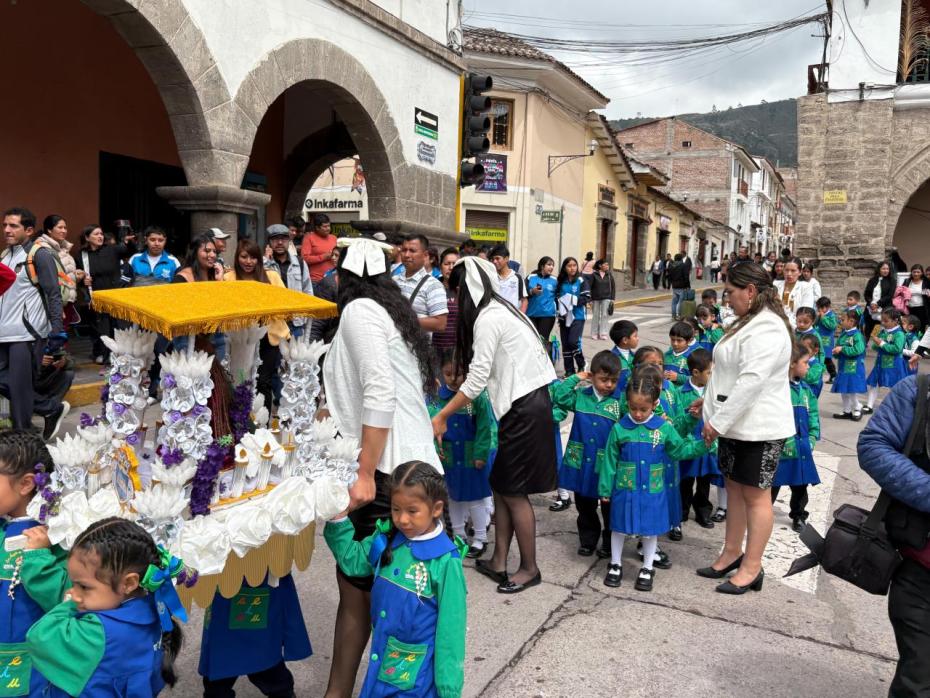
In the 500 years since the Spanish conquest of the territory, Catholicism played a hugely important role in shaping Peruvian society, at times in tandem and at times in competition with indigenous beliefs and practices and revolutionary and modern ideals. In the last 50 years, both progressive and conservative Catholic proponents have competed to reshape Catholic life in Peru by means of liberation theology or institutions like Opus Dei and Sodalitium Christianae Vitae. The impact of liberation theology has softened since its heyday, and the Sodalitum was suppressed by Pope Francis in 2024. Leaders like the Bishop of Chiclayo, Robert Prevost, who became Pope Leo XIV in 2025, tried to cut a middle path through, recognizing the ways that most Catholics lived and practiced in that middle. Amidst that, as is true elsewhere in Latin America, Evangelical churches have reshaped the religious landscape and the proportion of Catholics has shrunk.
From a cultural and geographical perspective, it helps to think of Peru as consisting of three zones, each running roughly north-south. The coastal lowlands, including the capital, Lima, are the most Westernized or globalized and where the great majority of the population lives. The Andes mountains, which run at high elevations like a spine down the center of the country, are home to Quechua and Aymara Indigenous peoples and their cultures. The largest zone, the Amazonian jungle east of the Andes, is home to people from dozens of cultures. Though it comprises 60% of Peruvian territory, this region is home to only 5% of Peru’s people.
The entries on Peru on this site thus far focus on the city of Ayacucho, a small city in the Andes whose mestizo culture bears witness to a mix of Quechua and European influences.
National Demographics
- 1 United Nations, Department of Economic and Social Affairs, Population Division, World Urbanization Prospects: The 2018 Revision, Online Edition (New York: United Nations, 2018).
- 2 United Nations, Department of Economic and Social Affairs, Population Division, International Migrant Stock 2020 (New York: United Nations, 2020).
- 3 Data as of 2021. United Nations Office on Drugs and Crime, "Intentional Homicide," United Nations, Accessed April 9, 2024; United Nations Office on Drugs and Crime, Global Study on Homicide 2023 (Vienna: United Nations, 2023).
- 4 "2023 Corruption Perceptions Index," Transparency International, Accessed April 9, 2024.
- 5 United Nations Children's Fund, The State of the World's Children 2023 (Florence: UNICEF Innocenti – Global Office of Research and Foresight, 2023).
- 6 International Telecommunication Union, "Individuals using the Internet (% of population)," The World Bank, Accessed April 24, 2024.
- 7 Poverty and Inequality Platform, "Poverty headcount ratio at $2.15 a day (2017 PPP) (% of population)," The World Bank, Accessed April 24, 2024.
- 8 World Economic Forum, Global Gender Gap Report 2023 (Geneva: World Economic Forum, 2023).
- 9 As Pew describes it, "Government restrictions on religion include laws, policies and actions that regulate and limit religious beliefs and practices. They also include policies that single out certain religious groups or ban certain practices; the granting of benefits to some religious groups but not others; and bureaucratic rules that require religious groups to register to receive benefits." As noted on pp. 45-47 of the report, the index summarizes data from 19 sources. The index does not differentiate whether the laws are directed toward Catholics. Pew Research Center, Globally, Government Restrictions on Religion Reached Peak Levels in 2021, While Social Hostilities Went Down (Pew Research Center, 2024).
- 10 As Pew describes it, "Social hostilities include actions by private individuals or groups that target religious groups; they also include actions by groups or individuals who use religion to restrict others. The SHI captures events such as religion-related harassment, mob violence, terrorism/militant activity, and hostilities over religious conversions or the wearing of religious symbols and clothing." As noted on pp. 45-47 of the report, the index summarizes data from 19 sources. The index does not differentiate whether the hostilities are directed toward Catholics. Pew Research Center, Globally, Government Restrictions on Religion Reached Peak Levels in 2021, While Social Hostilities Went Down (Pew Research Center, 2024).
Catholic Demographics
These statistics are derived from the Vatican's official publication, Statistical Yearbook of the Church 2022 (Vatican City: Librera Editrice Vaticana, 2024). The numbers may differ from data reported by other sources on this site.