-
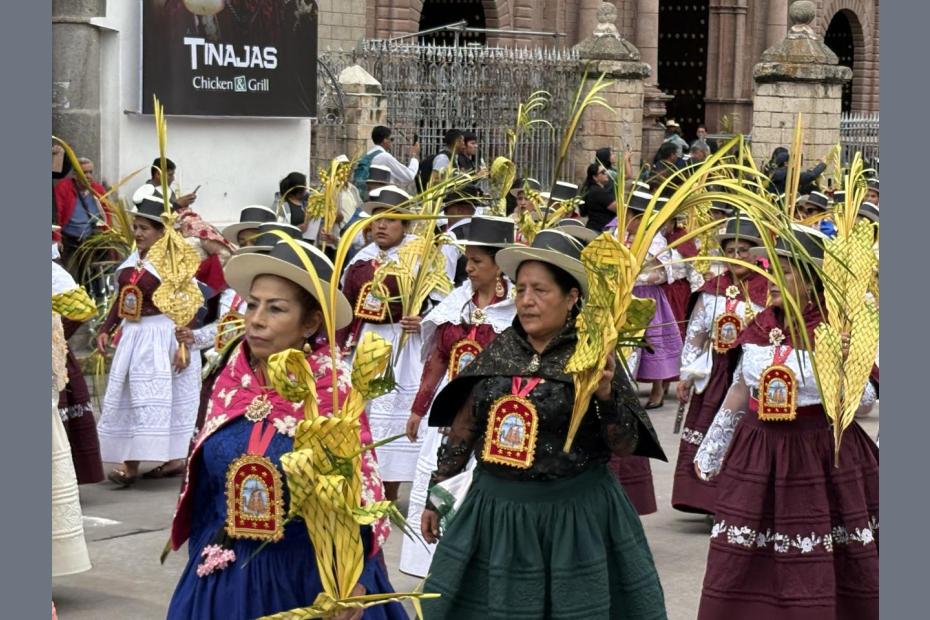
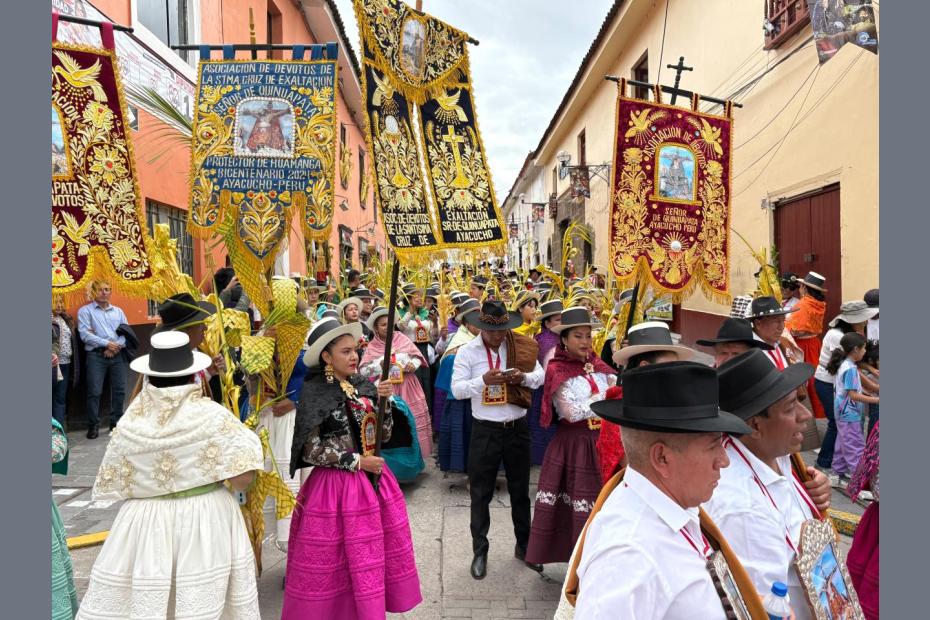 On Palm Sunday, leaders of various confraternities meet in procession. The outfits of the confraternity members hearken to Spanish colonial styles in Peru.
 -
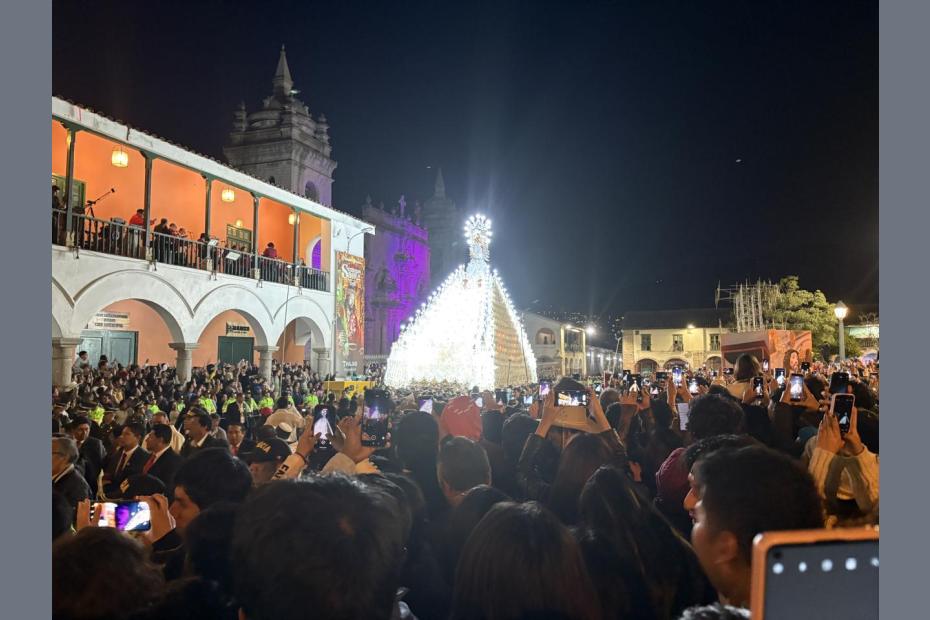 The largest and most significant anda, the Watay Throne, bearing the risen Christ on top, is carried out from the cathedral by 300 people who process it around the square, returning to the cathedral at dawn.
 -
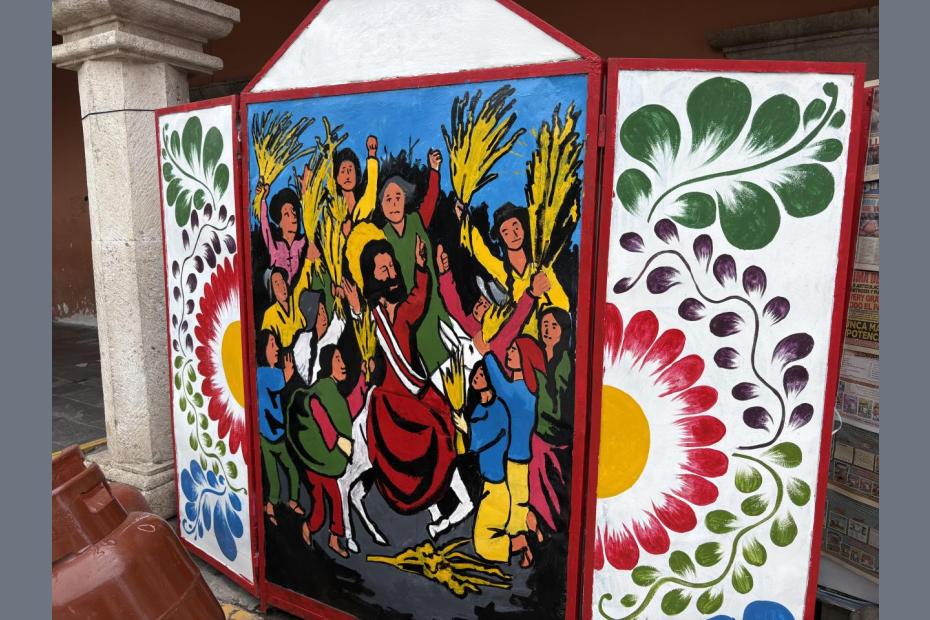 A Palm Sunday scene in the square in the folk art style particular to Ayacucho.
 -
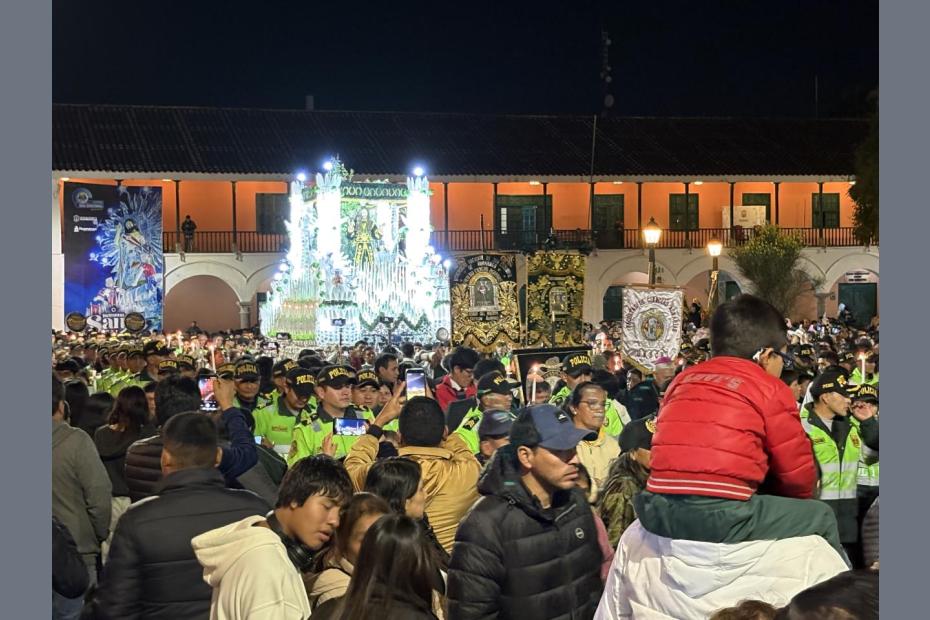 Oh the Monday of Holy Week, the image of Jesus in the garden of Gethsemane is brought from its church to the plaza.
 -
 Oh the Monday of Holy Week, the image of Jesus in the garden of Gethsemane is brought from its church to the plaza.
 -
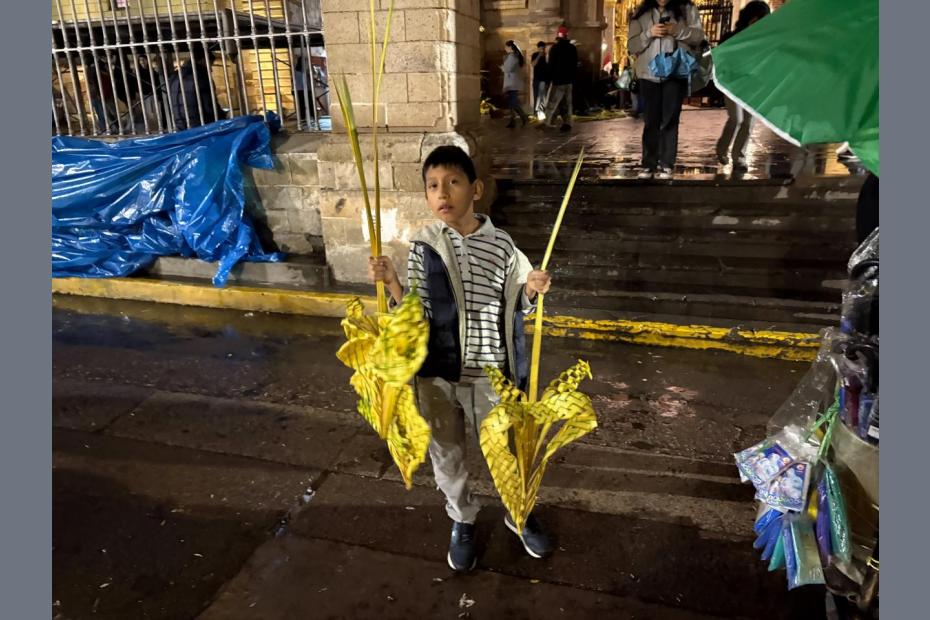 Adults and children , mostly recent migrants from Quechua villages, sell woven palms in preparation for Palm Sunday.
 -
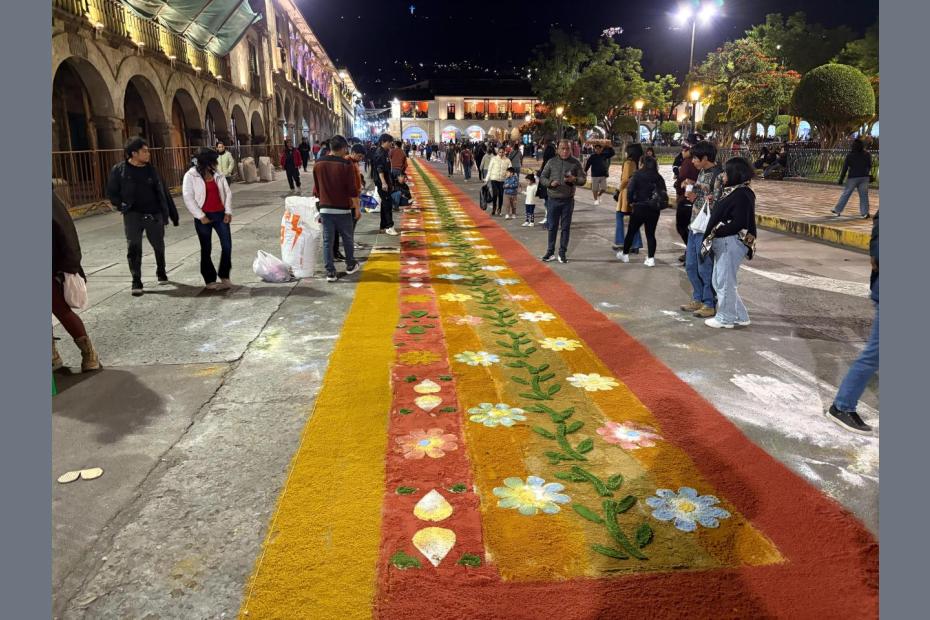 On Monday, of Holy Week, more alfombras are prepared for the procession, tonight of the Lord of the Garden, Jesus praying in Gethsemani.
 -
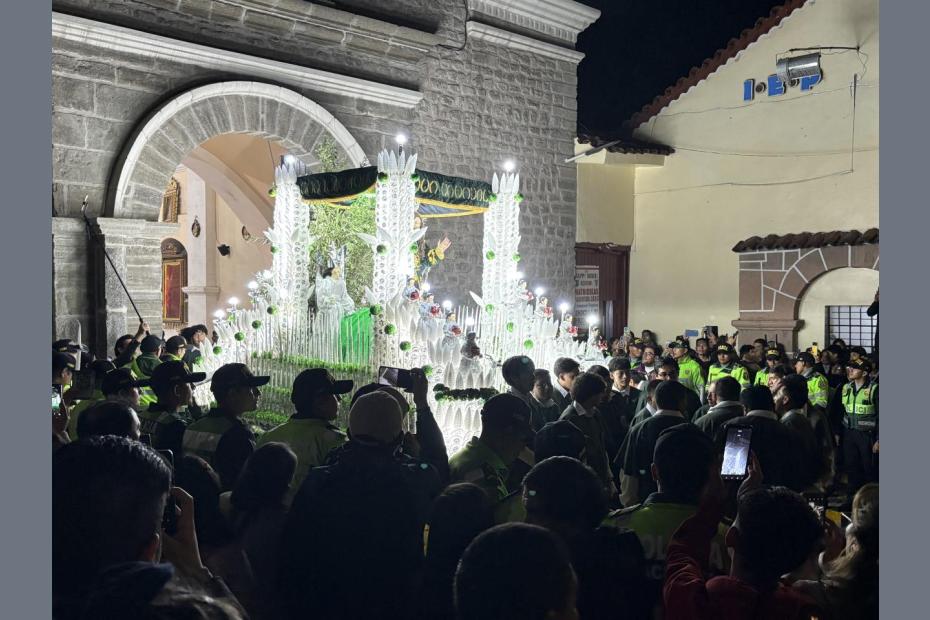 On Holy Monday, the images of el Señor del Huerto, the Lord in the garden of Gethsemane, is brought out from its home church.
 -
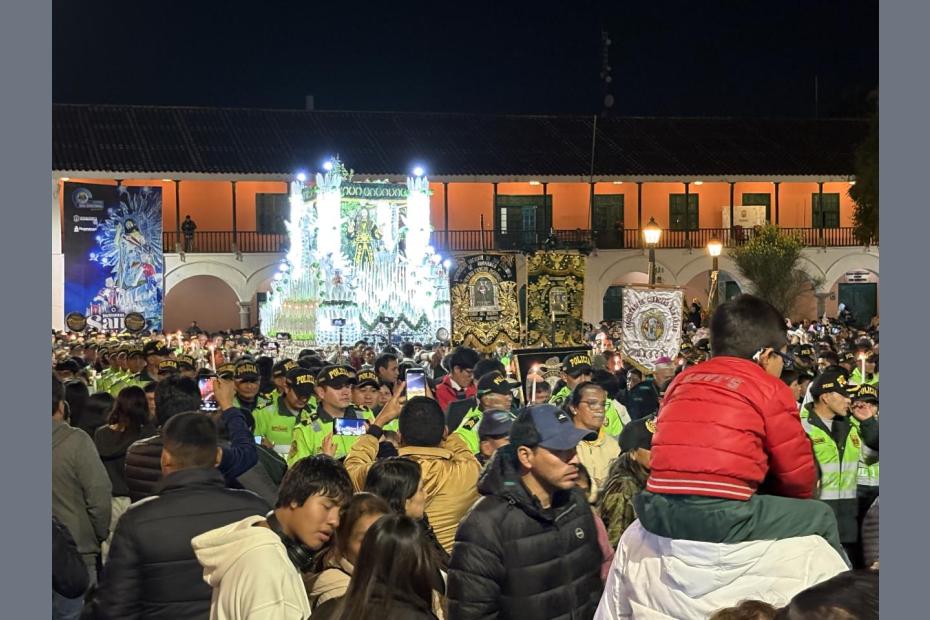 Oh the Monday of Holy Week, the image of Jesus in the garden of Gethsemane is brought from its church to the plaza.
 -
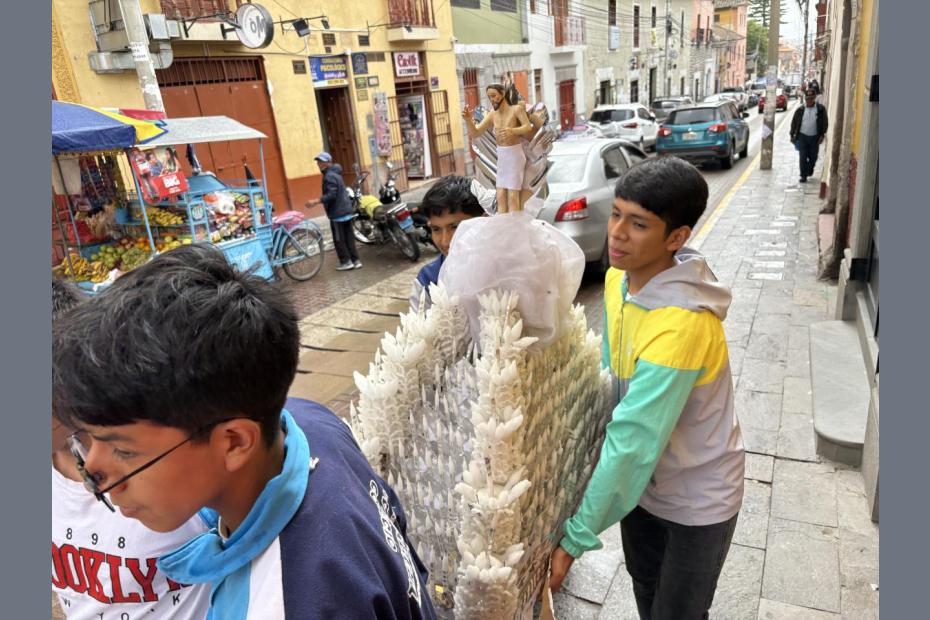 School children who have made a small copy of the Watay Throne bring it to their own small daytime procession.
 -
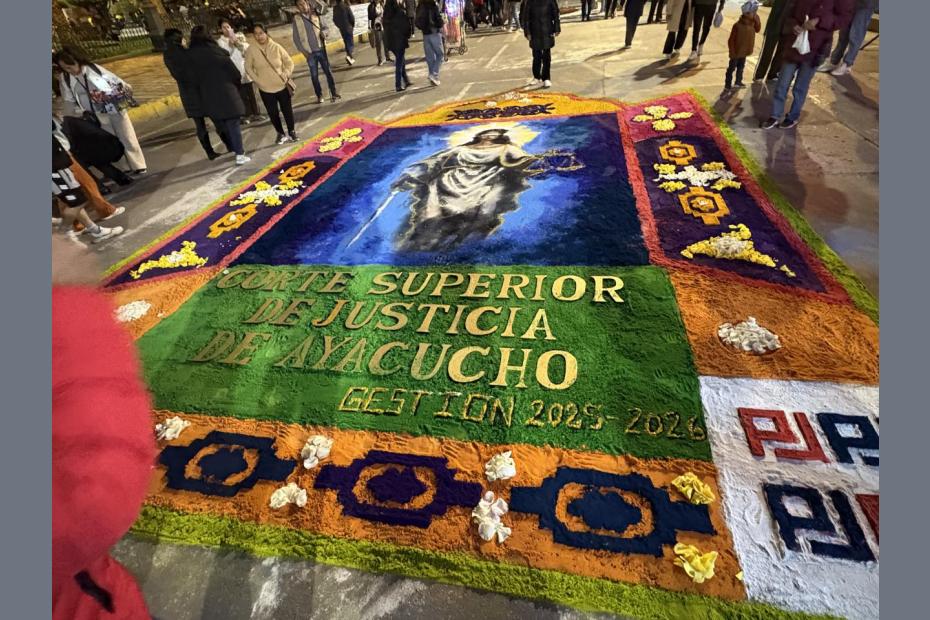 Tuesday's procession is decidated to el Señor de la Sentencia, Jesus being sentenced, and engages members of the justice system today.
 -
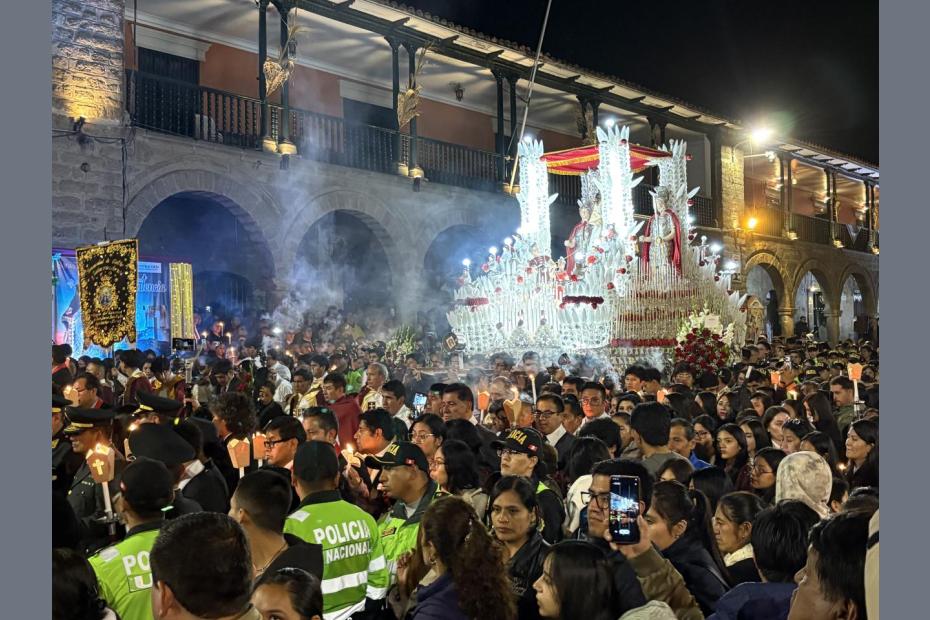 Tuesday's procession is decidated to el Señor de la Sentencia, Jesus being sentenced, and engages members of the justice system today.
 -
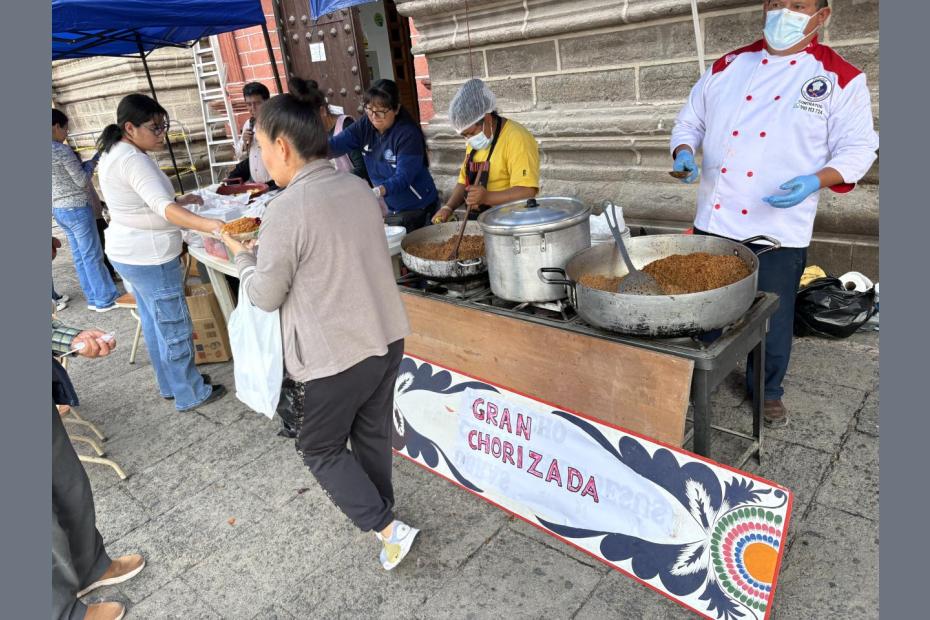 Chorizo, one of the food traditions of Holy Week in Ayacucho, for sale in front of a church.
 -
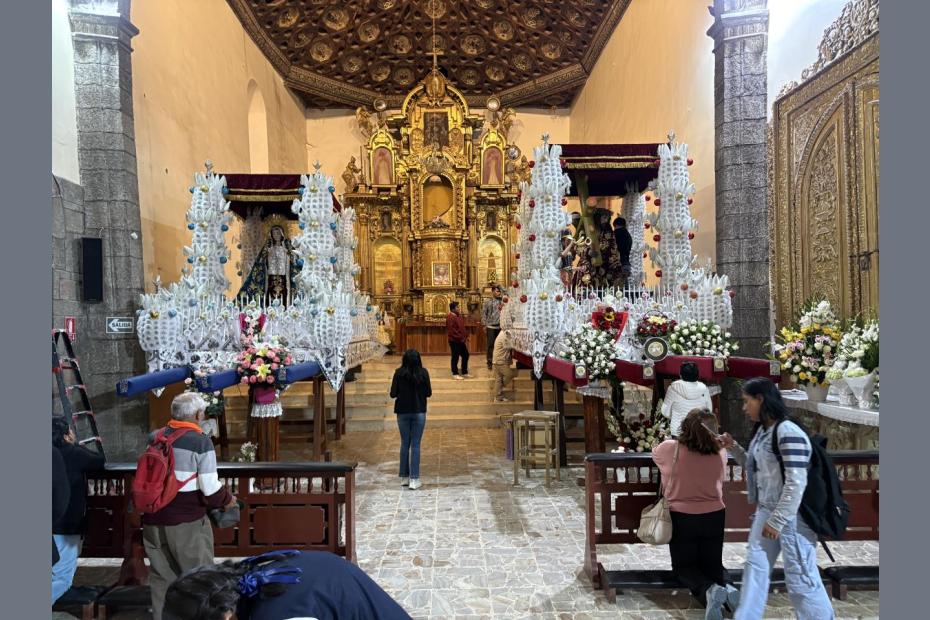 All of the andas are housed in historic churches, and on the day of the procession, many people will stop by to pray at them. Images fromthe popular Encuentro are in the Monastery of Santa Clara.
 -
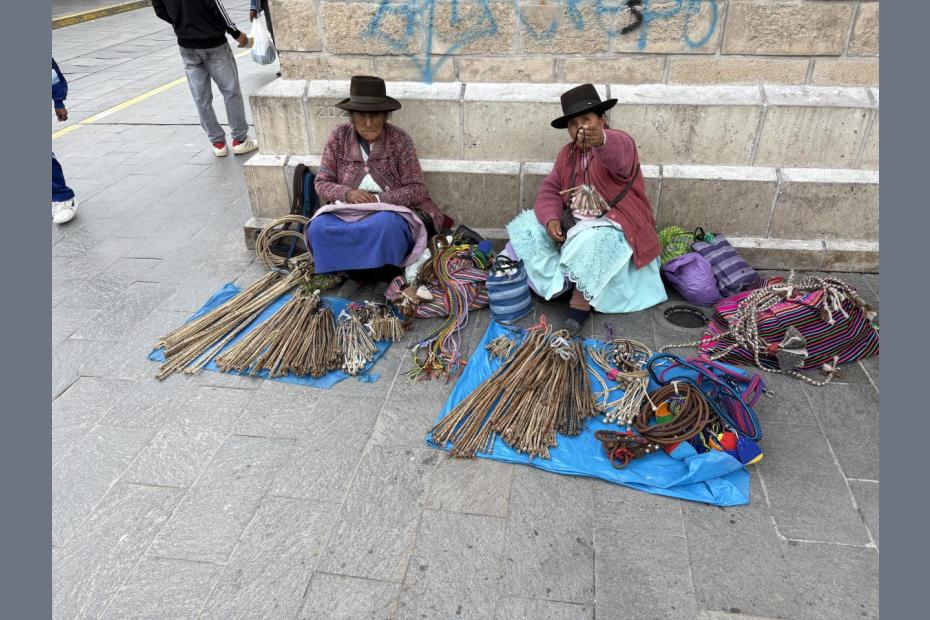 An old tradition of lightly whipping children in Good Friday so that they can "help" share in Jesus' suffering, is said to have disappeared, but notably, these women were selling those small whips outside one church in Ayacucho during Holy Week.
 -
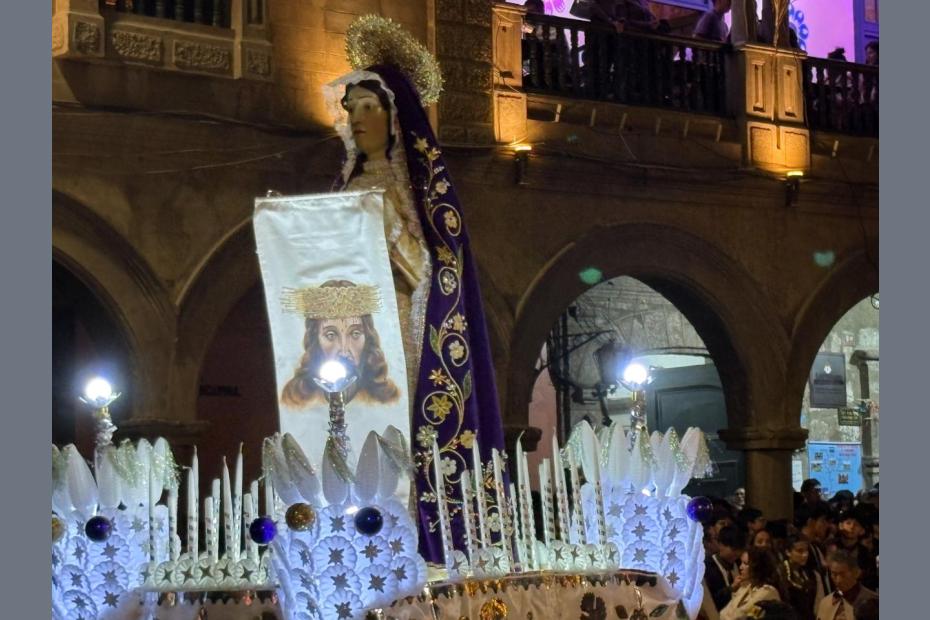 The image of St. Veronica after her encounter with Jesus. Note the white, tasseled corn cobs that are integral to every float.
 -
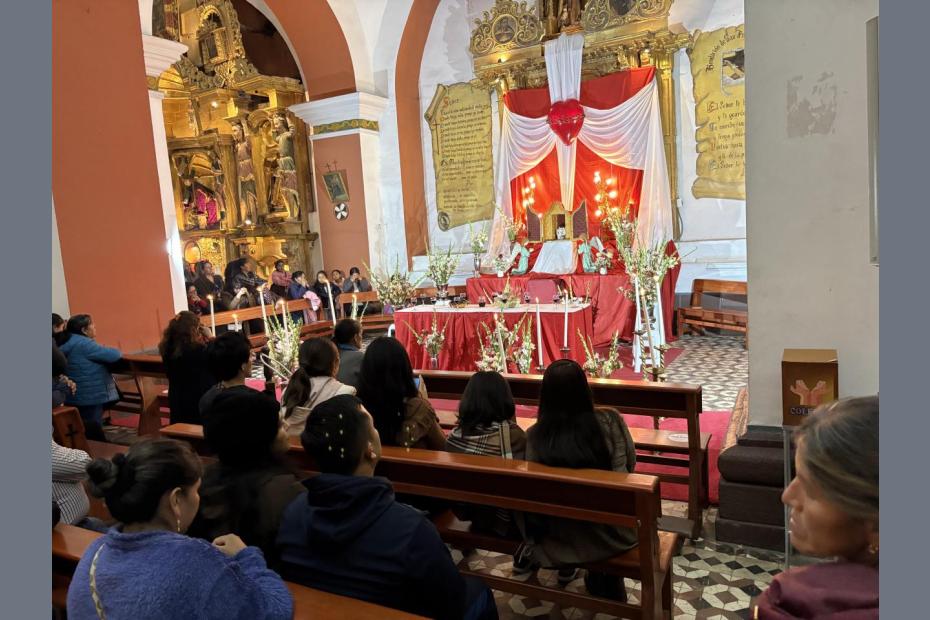 Devotees pray on Holy Thursday at the altar of repose at the Franciscan church in Ayacucho during siete iglesias visits.
 -
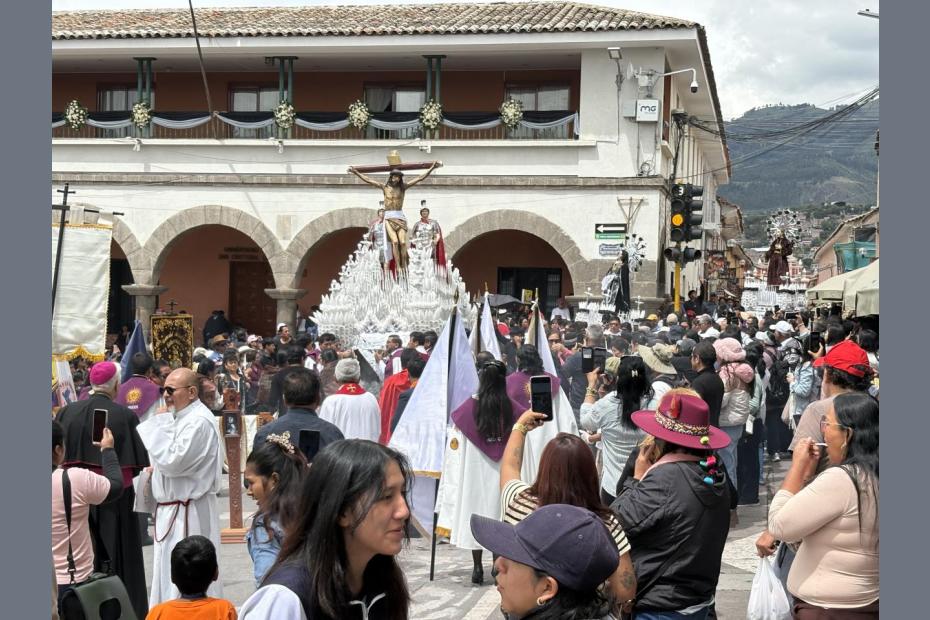 The statue of Christ crucified is carried through the plaza on Good Friday, followed by his sorrowful mother. This procession is a relatively new one, in the daytime, and is only modestly attended, though it falls during peak tourist days.
 -
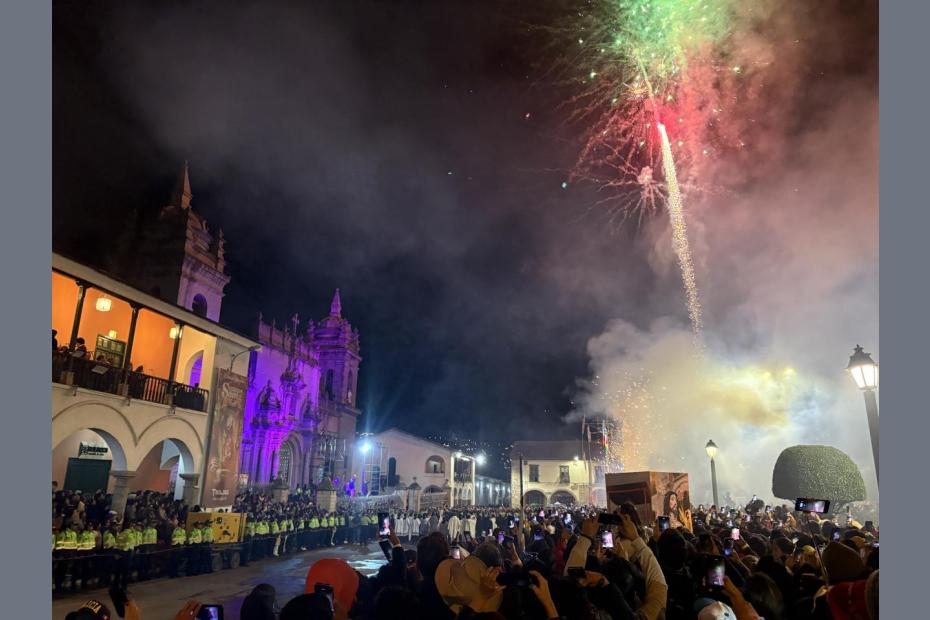 Fireworks shortly after 5 am alert the city that the Watay throne is about to process and Easter has arrived.
 -
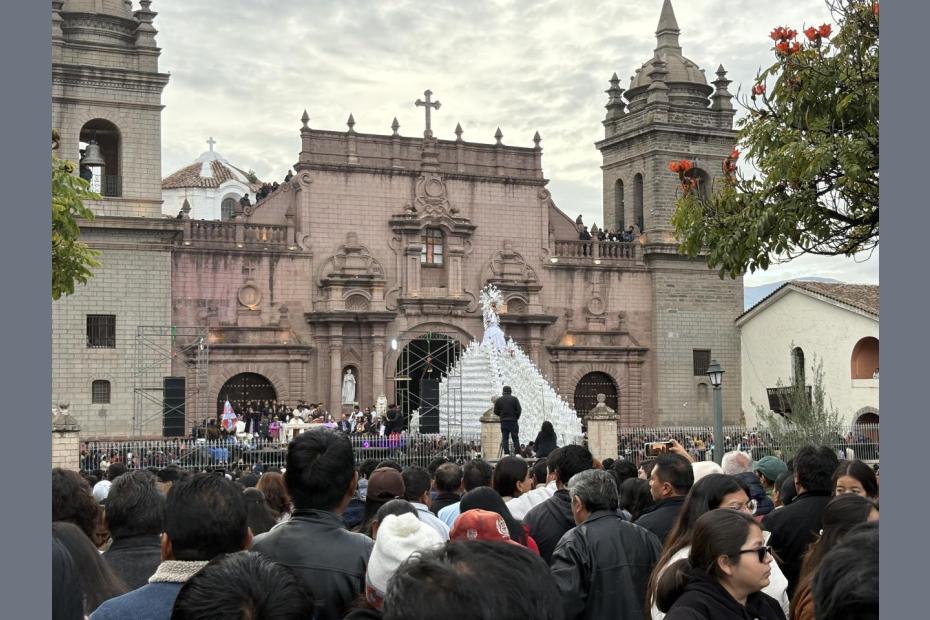 As dawn breaks, The image of the risen Christ returns to the cathedral before the outdoor Easter Mass.
In the Andes Mountains of Peru, 2760 meters (almost 1.75 miles) above sea level, Catholics observe Semana Santa – Holy Week – with a range of long-standing yet evolving rituals that tourism officials there like to promote as the second most important Holy Week celebration in the world. Over the course of ten days, the historic city center of Ayacucho is filled with activity, including daily processions, decorations, church visits, and particular foods that draw attention to the season. These events complement, and apparently for many Catholics supplant, liturgy as the primary form of commemoration of Holy Week.1 These rituals derive both from Spanish precedents and from the culture and context of the Andes.2
Beginning in 1540, shortly after the conquest of Peru, Spaniards built the city of San Juan de la Frontera de Huamanga, later renamed Ayacucho, on the site of an older indigenous settlement called Huamanga.3 Catholic missionary orders made it a base for evangelization in the region, building 33 churches during the colonial era. The processions at the heart of Holy Week commemorations in Ayacucho are a legacy of the strategies those missionaries used to reach the minds and hearts of the people they encountered.
The people of Ayacucho overwhelmingly identify as Quechua, the predominant indigenous ethnic group of the Andes.4 Still, the city is something of a cultural way-place. Some residents are recent immigrants from rural areas where indigenous culture and language hold greater sway. Quechua can still be heard at times on the streets, especially among street merchants, but daily affairs here are conducted in Spanish. Participants interviewed during Holy Week often recalled speaking Quechua with their parents or grandparents, but children in Ayacucho seldom speak Quechua. All of their classes are taught in Spanish. Liturgies are celebrated in Quechua only on special occasions.
In the 2017 census, 77.5% of the population in the urban region of Ayacucho identified as Catholic, 16.5% as Evangelical, and 4.3% as professing no religion.5
Origins and Evolution of Semana Santa Celebrations in Ayacucho
In the colonial era, processions were a frequent element of religious and social life in Ayacucho. The most important procession early on was on the feast of Corpus Christi.6 Their frequency was enhanced by a papal bull in 1607 that encouraged ceremonies involving “splendor and brilliance” as a way of drawing native people closer to the Christian God.7 In the 18th century, processions on Palm Sunday, Holy Wednesday, and the Triduum were incorporated into the religious life of Ayacucho and became the best-attended religious events of the year, organized by brotherhoods of native people.8
When Spain was defeated in the wars of independence, the bishop abandoned the diocese, and the city was left without leadership for years. Anthropologist Manuel Marzal has pointed out that in addition to the rupture created by episcopal abandonment, “a gradual but steadily increasing decline in the clergy began…to the point that by around 1950 it became necessary to rely on the assistance of foreign clergy, without being able to staff all parishes, especially in the Andean region… Moreover, independence also brought about a redefinition of the country as mestizo, with the consequent neglect and disparagement of Indigenous cultures, which continued to preserve colonial Christianity.”9 Semana Santa processions were exported from Spain to many parts of the world, but endure in few of those places. The factors highlighted by Marzal can help explain why these extra-liturgical forms of commemoration endured here.
In the 20th century, bishops took steps to regulate and supervise the processions and their lay leaders more carefully. Confraternity membership was limited to people known for their piety. The andas, the carrying platforms for the statues, became more elaborate, and beginning in the 1960s, at a time when mass devotional piety began to decline in many parts of the world after Vatican II, increased media exposure helped make Ayacucho something of a Holy Week destination in Peru.10
Although the city has expanded tenfold in the last century, official Holy Week processions are still confined to the colonial city and its stone churches. Even the inclusion not long ago of an anda from the Pampa San Augustin church, 400m from the cathedral, was rejected at first. “Even when they wouldn’t allow us to do it, the residents and stewards carried it out anyway” one parishioner reported.11
It would be a mistake to think of the celebration as a historically fixed ritual carried into the modern world. New elements–added processions, new brotherhoods, decorative alfombras lining the route, musical presentations at the cathedral and more–have been added in recent decades.12 Like many traditions, this is a practice that has changed over time, though all of the newer elements always seem to be expected to have some “traditional” characteristic that makes them feel congruent.
Considering the Rituals
It might seem tempting to some readers to label many of the Holy Week rituals as “popular religion,” implying some form of Catholicism separate from, or perhaps beneath, official Catholicism. However, the history of Holy Week celebration in Ayacucho makes clear that both Church authorities and laypeople have shaped the rituals. Its key rituals and organizational form were born from a missionary strategy, shaped in particular ways at various bishops’ insistence, but also led and preserved by lay people who find meaning in them. The archbishop and various clergy led every procession in 2026. All of them began and ended inside churches. The brotherhoods, which organized and paid for the processions and are organized around particular devotions, work in direct cooperation with diocesan and parish authorities. They “truly maintain a spiritual life, a social life… throughout the year,” one man reported.
While there are obvious affinities between Holy Week commemorations in Spain and Ayacucho, the processions in Ayacucho have a distinctive flow, schedule, rituals, and symbols. The traditions in Seville and Ayacucho both feature elaborate shoulder-carried andas bearing statues of Jesus, Mary, and other figures from the Passion story. Both cities’ processions are organized by lay brotherhoods. Ayacucho’s processions do not feature the famously hooded penitents who help make the processions in Seville, Ronda or other Spanish cities so prominent. The brotherhood members who process in Ayacucho, and even many of those who carry the andas, are publicly visible.13 Both processions are accompanied by brass bands, often playing similar music, but the music in Ayacucho also includes original hymns sung in Quechua.
In Spanish cities, the processions focus on the Passion. In Seville, for example, the intensity of the commemoration peaks from Holy Thursday through the night into Good Friday, and there is only a modest and comparatively not well-attended procession on Easter Sunday morning. In Ayacucho, the Passion is marked over many days, but the very largest anda, which dwarfs all the others in size and grandeur, bearing an image of Jesus resurrected, is the one brought out at dawn on Easter Sunday.
The colors and aesthetics of Ayacucho’s processions are often distinctly Andean colonial and mestizo. In the confraternity processions, women typically wear the type of hats and colorful skirts that were typical in the Spanish colonial era in the Andes. The andas tend to be white and silver-colored, decorated with wax figures shaped like corn cobs and pontiwayta flowers, native flowers that are often featured in local arts and crafts. Surprisingly, though, the direct symbolic purpose behind the use of corn cobs and pontiwayta flowers was not apparent to the devotees who were asked about it, despite the fact that their use, consistently employed from anda to anda, was a Quechua reference.
In unusual ways, food plays a special, locally particular role in Ayacucho during Holy Week, as another, holistic reminder of the season. For reasons no one could quite explain, candied apples were popular around the plaza. Chorizo, a dish made of ground pork and spices, and ponche, a drink made from sesame seeds, fruit, and peanuts, were also ubiquitous, at least through Holy Thursday. All could be found for sale along the streets, in restaurants, and even on the steps of churches, and associated with the season. While Chorizo disappears from the vendor stalls on Good Friday, Nelson Pereira reported that it is common to think of the prohibition of eating meat ending at 3 pm. “Because at that hour Christ has died and no longer sees that you are committing sin… after 3 p.m. you can eat meat… That's the popular belief.”14 On Easter morning, mondongo, a soup made of tripe, hominy, mutton, pepper, and mint, was suddenly everywhere to be found around the plaza after the morning procession and Mass, though others reported that lamb was their family's choice later in the day. Elements like Easter eggs or bunnies, key in many parts of the world, played no part in the celebrations here.
The Processions Day-by-Day
Holy Week commemorations in Ayacucho last ten days, starting on the Thursday before Palm Sunday. Every day through Good Friday is marked by a procession of a Passion-related statue from a historic church, past the cathedral, and around the main plaza. The grandest processional events are on Palm Sunday, Holy Wednesday, and Easter at dawn.
The nightly processional spectacle is enhanced by elaborate, brightly-colored alfombras–carpets made of sawdust and flower petals to decorate the pathway of each procession. While the alfombras were formally sponsored by schools, social service and religious agencies, it was the city’s youth who carried out the implementation and who seemed to embrace the work with enthusiasm. Some alfombras were even sponsored by government water and highway projects. They typically included an explicitly Catholic element like a dove in the sky above a new bridge, as if to suggest that the Spirit is looking down upon the project. Some alfombras used explicitly Catholic images, but many people questioned whether it was appropriate to be trampling sacred images in the procession. The processional alfombra is a tradition historically tied to Spain, but most visible today in places like Ouro Preto, Brazil; Camaiore, Italy; and Antigua, Guatemala, but in reality, they are a late 20th-century addition to Holy Week in Ayacucho.
The alfombras certainly draw attention to the processions, as pedestrians gather to look at them, but what also stands out is their ephemerality. Each day, for hours beforehand, young people mark out assigned spots along the processional pathway, sketching out and filling in bright patterns and images. In several instances, they were just finishing in time for the processions to begin. But even as the procession approaches and the crowd gathers, attention quickly turns away from them to the statue on the anda. The procession smudges the colorful carpet into a mess, and it is swept up soon afterwards. By design, their beauty disappears quickly.
Passion Saturday’s procession features an image of the Señor de la Parra, the Lord of the Grapevine, a statue of Jesus holding grapes, linking the wine brought to the Last Supper as a foreshadowing of the blood Jesus was about to shed.
Palm Sunday’s major early morning procession brings a statue known as the Lord of Palms from the cathedral to the Temple of Santa Teresa and back to the cathedral and plaza in the afternoon, though in 2026, early morning rains interfered. As the weather cleared, crowds gathered in churches and their plazas with large, woven palm fronds, and sometimes processed through the streets. One person noted that this procession had a greater proportion of working-class people and rural people than most of the others did.
Monday of Holy Week brings a statue called el Señor del Huerto, the Lord of the Garden, depicting Jesus in agony in Gethsemane; Tuesday night brings out an image called the Lord of the Sentence, depicting Jesus in thorns and tortured after his arrest. Notably, the Mass offered that day at the image’s home church is designed to gather people who work in the criminal justice system.
Asked what the most powerful moment was for them during Holy Week, several women reported that it was not during what are often elsewhere regarded as the key days of Holy Week, but rather at the procession on Wednesday known as el Encuentro. That procession features four images: two large ones, the Lord in Agony, an image of Jesus carrying his cross on the road to Calvary; the Sorrowful Virgin, his mother; and two smaller images of St. John and St. Veronica. According to Prof. Nelson Pereira, it is the oldest procession in the series.15 The statue of Jesus is brought to the plaza, successively encountering the andas carrying St. John and St. Veronica, and last of all his grieving mother. The process unfolds slowly and includes many hymns, including some in Quechua. Each time, the large heavy andas carrying the statues are tilted as if to bow towards each other, a move that the crowds of observers clearly found evocative. By the time the encounter of Jesus and Mary took place, rainfall brought out a sea of umbrellas, but the procession went on.
On Holy Thursday, following liturgies in each of the churches, there was a procession featuring an image of Jesus called Christ, Savior of the World, a primitive-style statue of a deeply suffering Jesus with a crown of thorns. This procession drew fewer onlookers than on Wednesday. On the other hand, crowds of devotees filled the streets and key colonial churches for siete iglesias, an early modern Roman tradition entailing visits to seven churches that evening, still practiced in some countries, including the Philippines and Malta.
Inside the churches, people stopped to pray at images related to Jesus’ Passion, often touching the anda or, in the Dominican Church, for example, the glass that protected the image of the dead Jesus in the Holy Sepulchre. The visits to that image seemed much like a wake. People lined up to visit the body briefly, paid their respects, and then moved on. The largest crowds gathered around altars of repose. Traditionally, several people reported, those who visited seven churches could make “a wish” for having done so, but this was reported as if that was a thing that people wouldn’t really do today. One could think of the visits as a kind of catechesis, whereby each visited statue recounts part of the Passion story, or as a visit to a suffering or deceased friend. As one might do at a wake, after visiting the deceased, visitors turned and spoke to living friends in the crowd. Back out in the streets, musicians and Quechua dance troupes helped fill the streets with energy.
Several Good Friday processions drew modest groups, primarily confraternity members and parishioners. One, in the morning, beginning at the Jesuit church, was of Jesus crucified, followed by his grieving mother and two disciples. While these images and their anda were similar to Wednesday’s Encuentro, the crowds were much smaller. The Jesus crucified procession, in fact, is a recent addition. He is processed from the Jesuit church to the cathedral for the preaching on the Seven Last Words, and then back. A new brotherhood, the Cofradía de la Soledad, founded in 2022 and inspired by an ancient cofradía of that name from Lima, sponsored a procession of Jesus being taken down from the Cross and Our Lady of Solitude in an area just below the plaza. In the Franciscan church, the homily on the Seven Last Words was preached in Quechua, one of the few occasions when Quechua is used. A procession of Jesus in the Holy Sepulchre, followed by Our Lady of Sorrows, departed in the evening from the Dominican Church.
One Good Friday ritual–a private, not public one–bears mention. Interviewees described it as a thing of the past: on Good Friday morning, parents would whip the backs of their children with three lashes, “Because Christ had to be helped to suffer,” as one man described it. “It's symbolic, but it has to hurt. Because you have to feel Christ's pain in your body. My dad tells me that on Good Friday, very early, my grandmother would wake them up [to do it].” In Ayacucho, he claimed, “If I do that, in half an hour I'll be at the police station.” Yet soon after it was first mentioned to me, I encountered two Quechua-speaking women sitting outside a much-visited church selling the cords used for the ritual. Someone, presumably, was still buying them.
Holy Saturday is marked by the city and by tourism officials in a way that seems at odds with Holy Week, at an event called Pascua Toro, a running of the bulls.16 Historically, bulls destined as gifts for charitable institutions would be released in the center of the plaza on Holy Saturday, and revelers dressed in red would taunt and run from them. Amid controversy that it had devolved into touristic drunkenness and disorder, it was canceled in 2018, and for the last five years has been held at a site 3 km from the central plaza, to distance it from the religious commemorations, but hold on to the tourism revenue.17 Still, Pascua Toro tee shirts were visible around the central plaza, and the plaza was full of drunkenness and dancing into the night, despite signs at entrances forbidding public drinking. Several young people suggested that it would be better to avoid the place, and that some people there came to the city only to pickpocket.
Inside the cathedral, on one edge of the square, the giant, tiered white anda known as the Watay Throne, with a statue of Christ resurrected on top, took up about half of the interior seating. People came in throughout the day to visit the anda up close, before the procession.
By 4 am on Easter morning, the square smelled as sanitation workers and garbage trucks lined the plaza, cleaning up in preparation for the madruga, the dawn procession. Even during the procession, some hangers-on were inebriated, but a different crowd had arrived. Perhaps for those who stayed on from the previous night, repeated references by the emcee about Jesus as “the one who comes to take away our sins” resonated differently.
At 5 am, while it was still dark, an image of Jesus resurrected was carried out the front door of the cathedral on top of the Watay Throne, which stood out as bright white in the dark. The 3 metric ton anda, carried by more than 300 devotees, is so tall that the statue had to be mechanically lowered to allow it to process out. From the time it reached the square, the biggest job for the police was keeping people from trying to break the cordon to carry the giant anda. Many were pulled away when they tried. It took almost an hour to carry the anda all the way around the square. Several times it tilted perilously, and people gasped. They clapped when it was lifted well.
Following the procession, the archbishop, who had been present leading all the official processions, celebrated Mass outdoors from the front of the cathedral. Advertisements had described it as a Mass in Quechua, which happens only at Easter now, but most of it was in Spanish. Mass was well attended outdoors, but it is still notable that about half the attendees at the madruga procession left before or early in the Mass. As one person explained, “For people, Mass is not important. It’s the anda, the procession, that is their way of celebrating Easter.”
Tradition Amidst the Push and Pull of Tourism
Holy Week celebrations in Ayacucho are part of a long Catholic tradition of using spectacle as a means to foster Christian devotion. For some Holy Week participants, this surely works. By all accounts at Ayacucho, these were also events that some people came to merely to observe for their aesthetic value or novelty. One woman admitted that she had long attended with her family as “a tradition, a custom,” but “I didn't feel anything.”
Historian and anthropologist Nelson Pereira summed up the challenge: “Holy Week, in the last 30 years, has become Ayacucho's most important tourist attraction. It's the only time of year when tourists come to Ayacucho, and not just to experience Holy Week, but also the other tourist attractions: archaeological ruins, landscapes, food, and so on.”18 The Pascua Toro is certainly one manifestation of that, alongside craft fairs and food fairs. Many vendors come to the city just to participate in that business.
Pereira described several ways that the archdiocese is trying to draw the focus back from being an event just to be observed, “a tourist attraction where many people come just to see and be entertained,” into one meant to draw people into its true meaning.19
Yet the brotherhoods, not the tourist agencies, bear most of the costs of organizing the processions. Their members commit themselves year-round to activities that interweave their own spiritual and social meanings. Their processions, combining devotion, a form of evangelizational pedagogy, communal and personal identity-building, and a sense of belonging to a tradition, intersect with the public and touristic gaze in the processions.
- 1Pastors do encourage prioritization of the liturgies, interviewees reported. As one put it, the priests say, “Okay, go to the procession, all that, but mainly go to these liturgical ceremonies… That's the most important thing… But it's the other way around; more people go to the procession.” The core of this article is based on numerous informal interactions and observations over nine days during Holy Week, 2026, along with six formal interviews. Special thanks is due to Ivana Allcahuaman Gamboa, who arranged a number of the interviews and helped with translation, and to my Holy Cross colleagues Jermani Ojeda-Ludena, a Quechua scholar, and Kyle Wooley for their help, feedback, and advice.
- 2While Ayacucho’s Semana Santa celebrations draw wider attention, other Andean versions were mentioned by interviewees, including in Huanta, not far from here, and Tarma, 8 hours north.
- 3The city’s name was changed to Ayacucho in 1825, in honor of a decisive battle nearby that helped Peru achieve independence from Spain.
- 4The 2017 Peruvian census offers data on the entire Department of Ayacucho, an area much larger than the city of the same name, but it does differentiate between urban and rural areas. In the urban parts of Ayacucho Department, 77.4% of the population identified as Quechua, 15.9% as mestizo, i.e. mixed European and indigenous, and 2.1% as white. Instituto Nacional de Estadística e Informática, Ayacucho:Resultados Definitivos, Tome I, 39.
- 5 The data apply to the urban area of Huamanga province. Instituto Nacional de Estadística e Informática, Ayacucho: Resultados Definitivos, Tome VI, 5791.
- 6 Jhoel Angel Amiquero Prado, Historia, Religión, y Tradición de una Fiesta: La Semana Santa en Ayacucho Centro de Investigatión Historico Social de Ayacucho, 2016, 14.
- 7Amiquero Prado, 15.
- 8Amiquero Prado, 22-23
- 9Marzal, Manuel M. El Sincretismo Iberoamericano : un estudio comparativo sobre los quechuas (Cusco), los mayas (Chiapas) y los africanos (Bahía), Pontificia Universidad Católica del Perú, Fondo Editorial, 108, translated by Raúl Zegarra and cited in his forthcoming chapter, “Peru” in The Catholic World, ed. Mathew Schmalz and Thomas M. Landy, Routledge, 2027, n.p.
- 10Amiquero Prado, 40-41.
- 11Amiquero Prado, 45.
- 12 Despite the name, the brotherhoods include both men and women. That word, rather than confraternities, is used here.
- 13Paradoxically, in Sevilla and other places in Spain, people in the brotherhoods and their families clearly knew who was who under the hoods, but the symbolism remains. In both Peru and Spain, it seems to be an honor to process, and that honor is only somewhat obscured in Spain. The one exception that could be noted is evident in photos of the recently formed Cofradía de la Soledad. Though not witnessed directly during this research, some of its Facebook pages show women members in Sevillan mantillas and some people in the procession in the same famous hooded garb as in Sevilla.
- 14He also notes that the choice of foods has evolved as well. Two generations ago, pumpkins and humitas were the dishes for Holy Week during fasting. Nelson Pereira, personal interview, April 21, 2026, Universidad Nacional de San Cristóbal de Huamanga.
- 15Personal interview, April 21, 2026, Universidad Nacional de San Cristóbal de Huamanga.
- 16Amiquero Prado, 45-46.
- 17See, for example, “‘Pascua Toro': ¿Turismo de 'borrachera' en Ayacucho o turismo de calidad?"
- 18 Personal interview, April 21, 2026, Universidad Nacional de San Cristóbal de Huamanga.
- 19 Interview with historian Nelson Ernesto Pereira, San Cristóbal de Huamanga University, April 1, 2026.