-
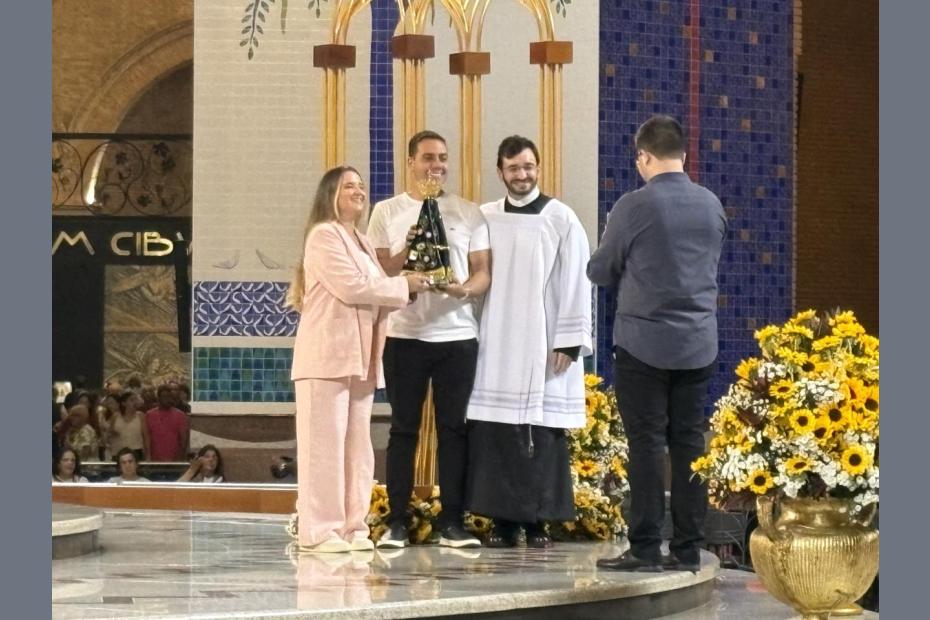 Inside the shrine, at the main altar, a young couple has a chance to hold and be photographed with the image of Our Lady Aperecida that is on display at the main altar.
 -
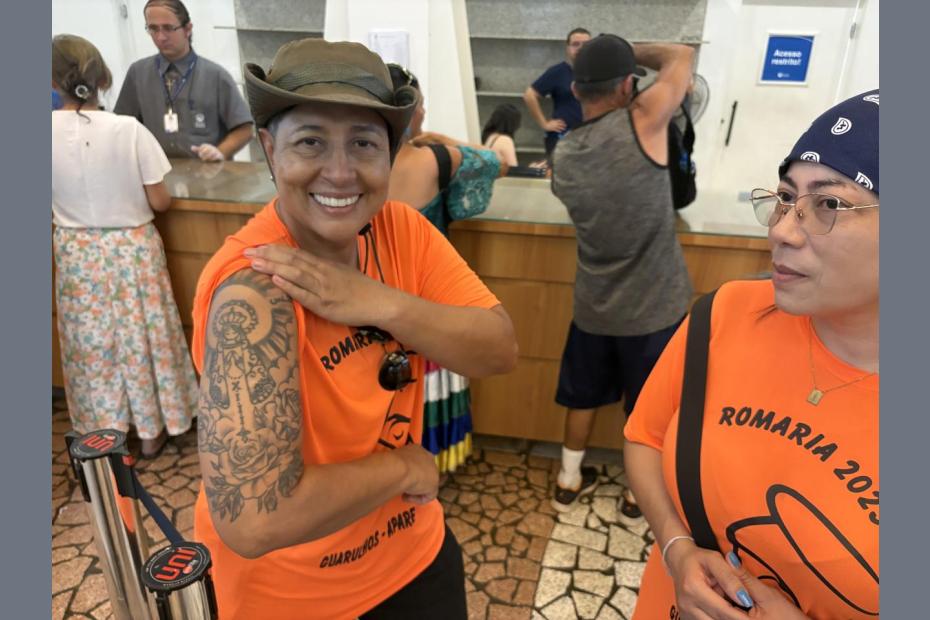 Near the desk where pilgrims can leave ex-voto offerings, one woman explained her devotion and even shows how she wears this sign of it.
 -
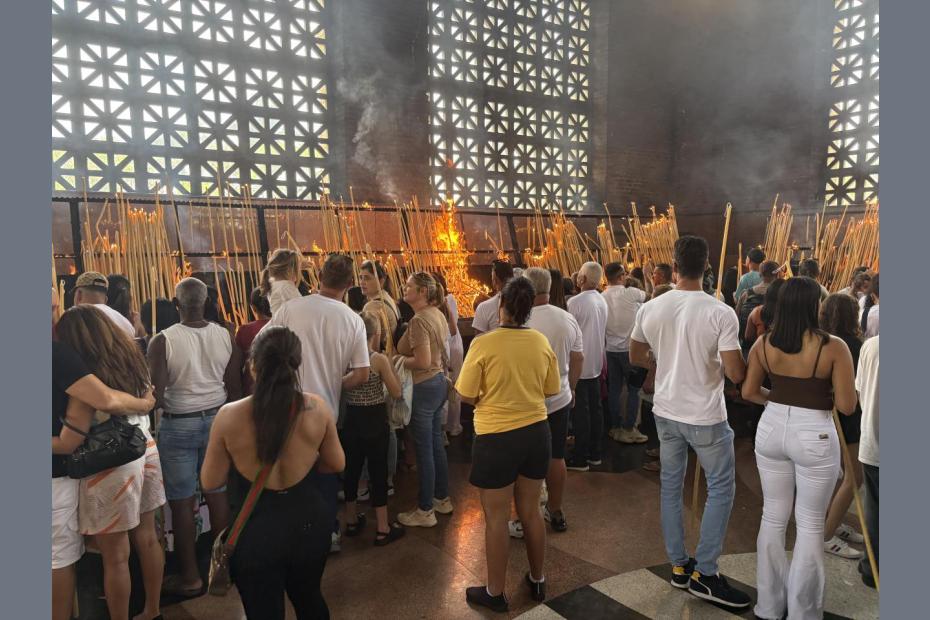 A large room is dedicated to placement of candles as offerings. The heat from the flames is felt even at a distance. One tradition is to buy and burn a candle the height of the person being prayed for.
 -
-
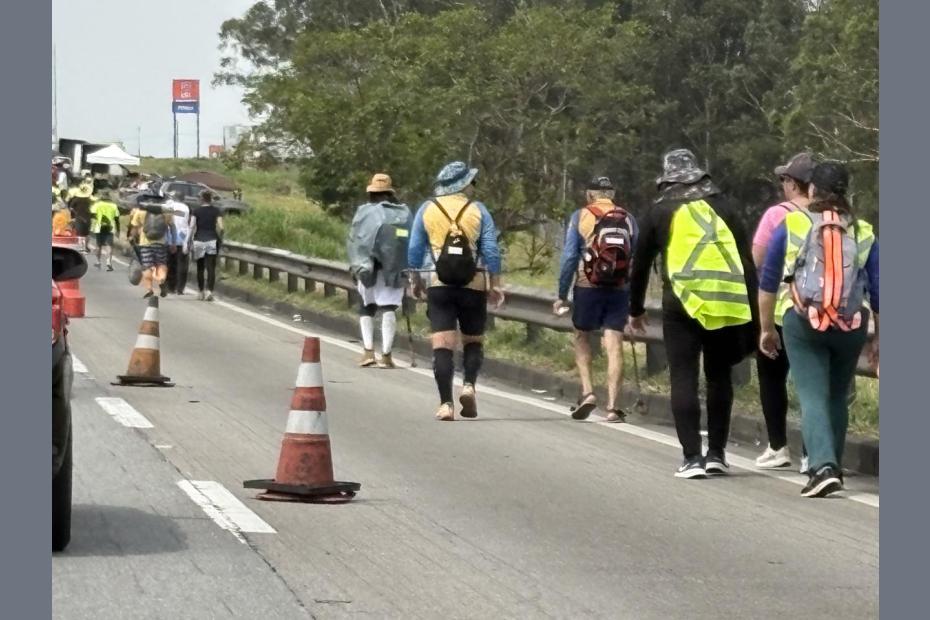
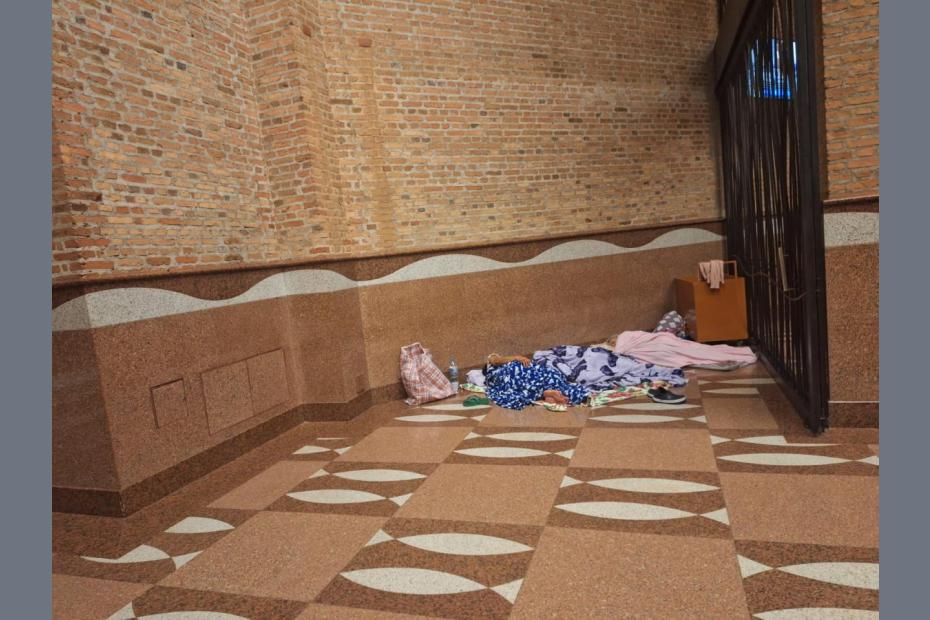
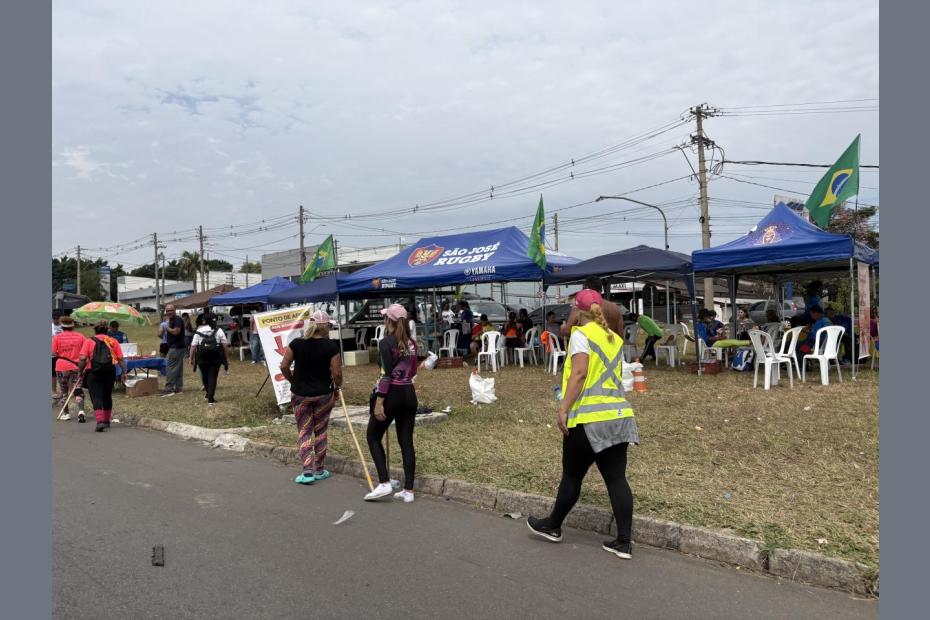 Other devotees, as a sign of devotion and a charitable work, staff stations along the pilgrimage route to provide food, rest and safe places for pilgrims to sleep.
 -
-
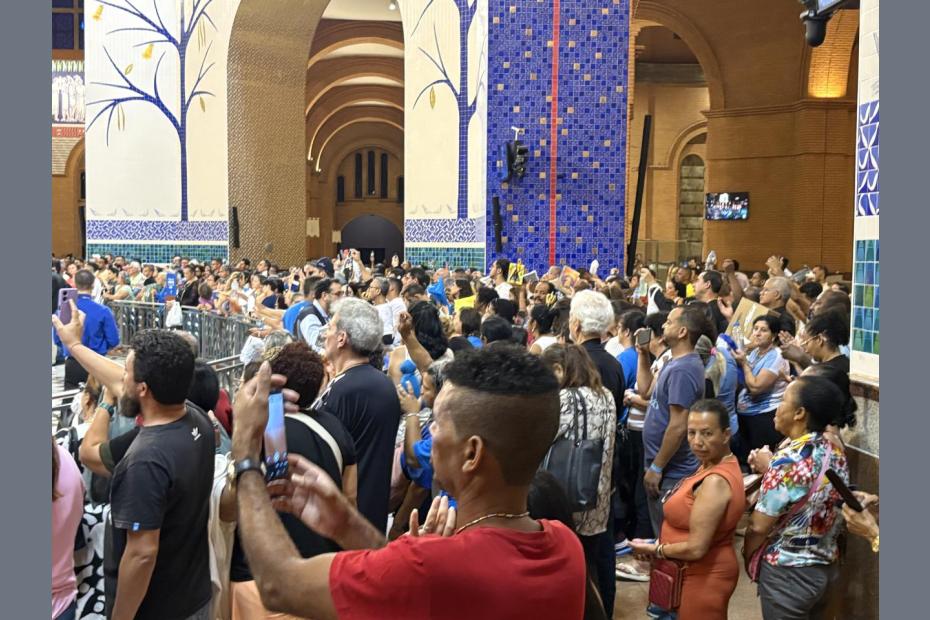 Around the main altar, devotees not only take pictures, but live stream for family and friends who cannot be present on the feast.
 -
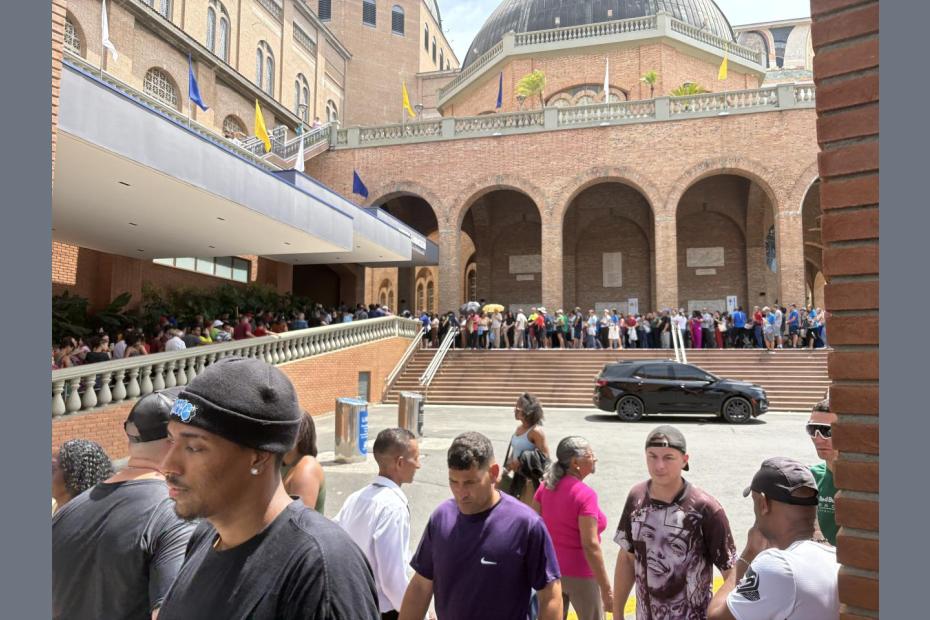 On the side of the shrine, pilgrims line up to see the original image of Our Lady Aperecida.
 -
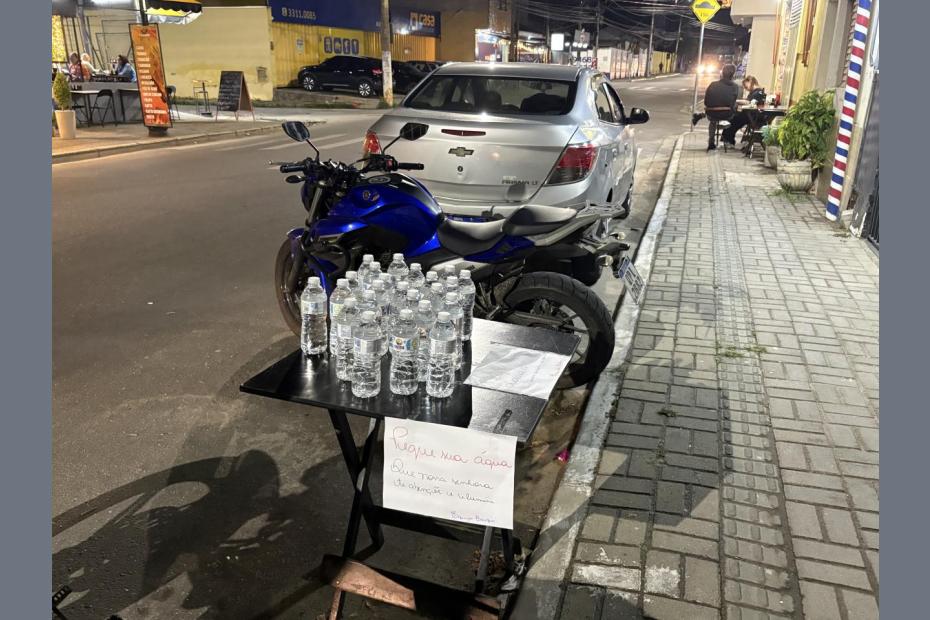 In the nearby town, even some distance from the Shrine, a local devotee provides free water to welcome pilgrims on the eve of the feast. "Take your water. May our lady bless and enlighten you," the sign reads.
 -
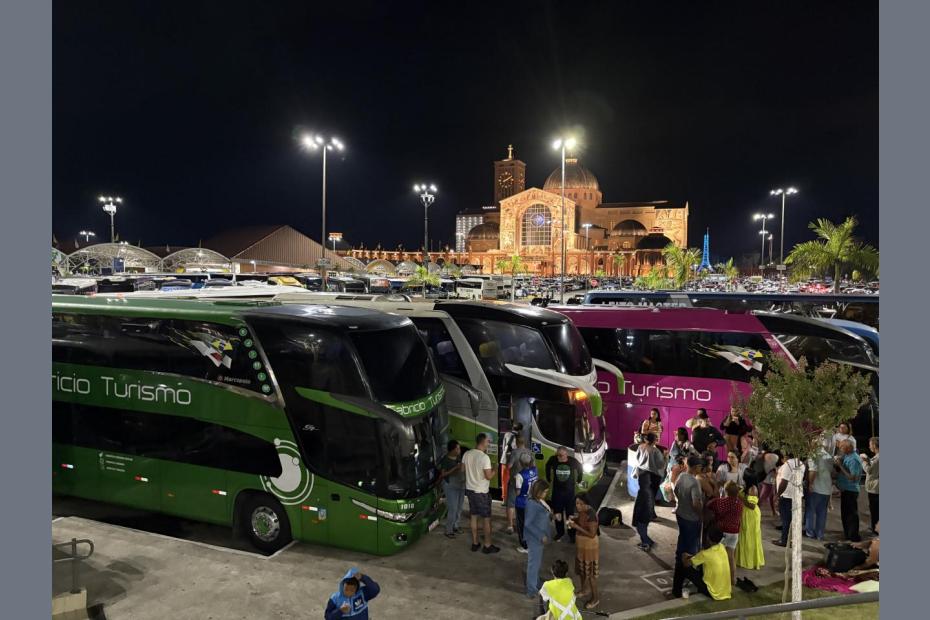 The shrine has parking for 2000 buses and 3000 cars, and runs two high-rise hotels. There are more than 50 hotels close by, with more under construction.
 -
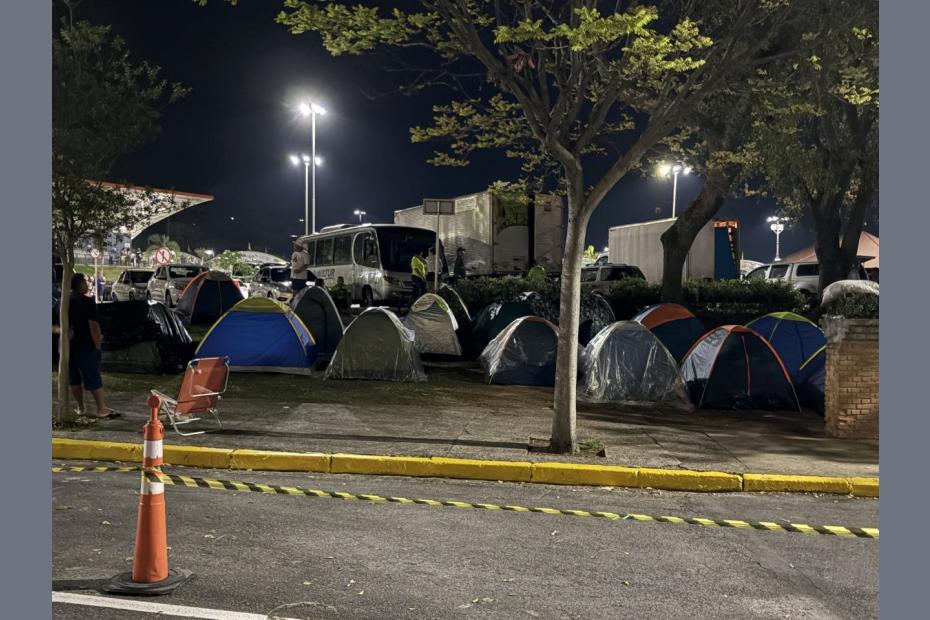 The shrine has parking for 2000 buses and 3000 cars, and runs two high-rise hotels. There are more than 50 hotels close by, with more under construction.
 -
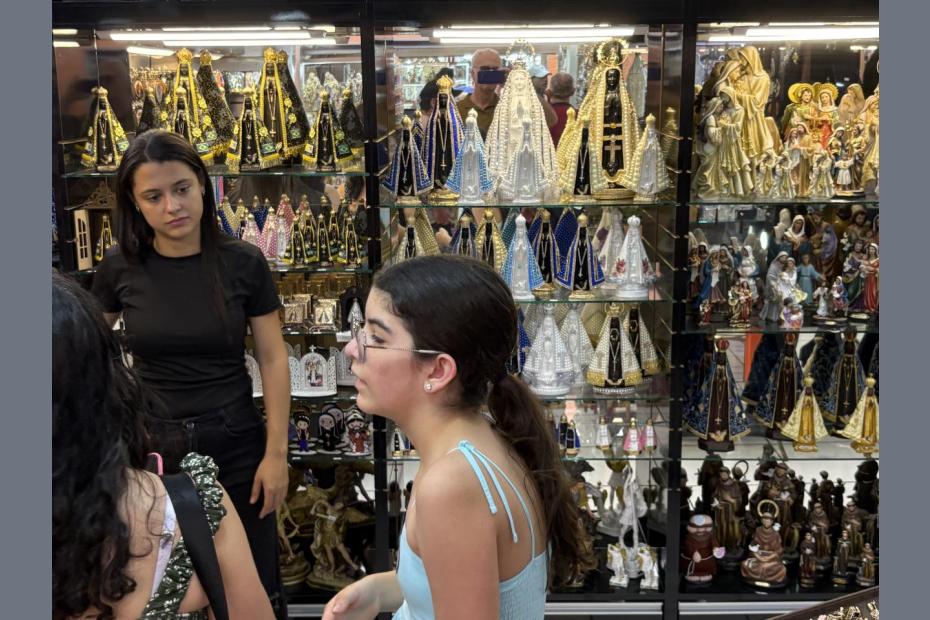 One of a large number of religious goods stores in covered shopping and food court. Note that in the center, some of the traditionally brown images of Aparecida have been re-rendered in white.
 -
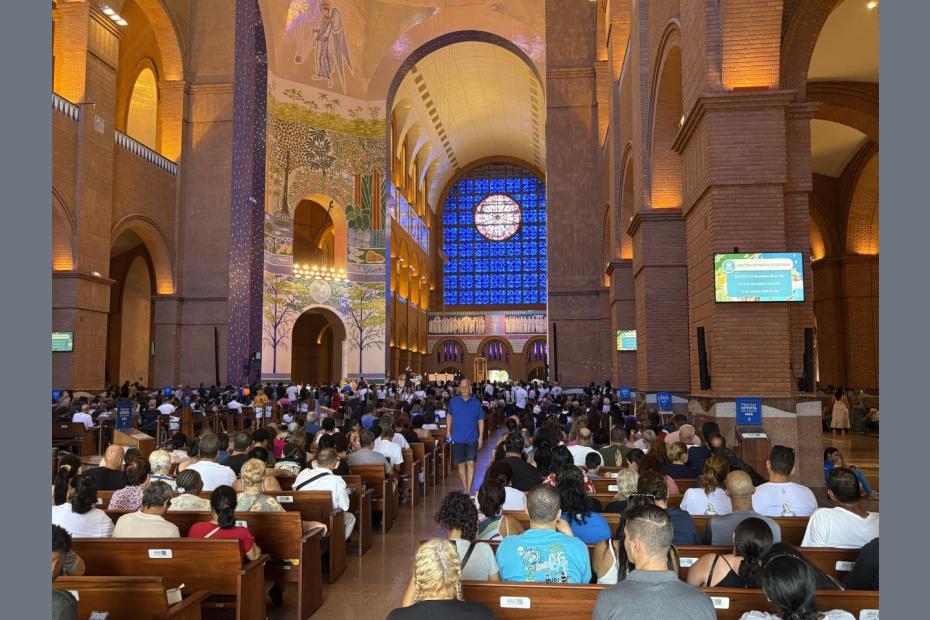
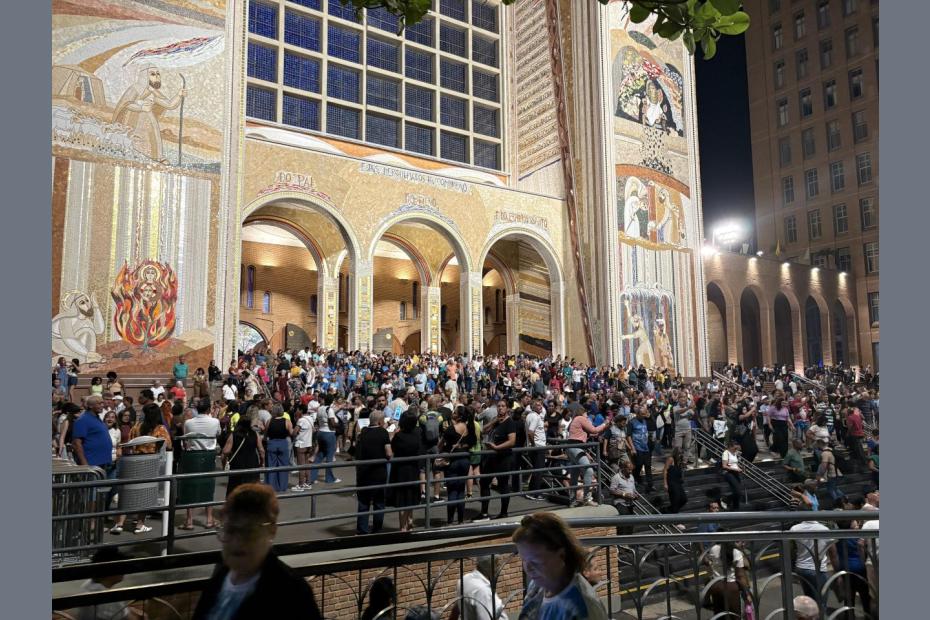 Crowds on the eve of the feast. The church has been recently re-surfaced in Marco Rupnik murals.
 -
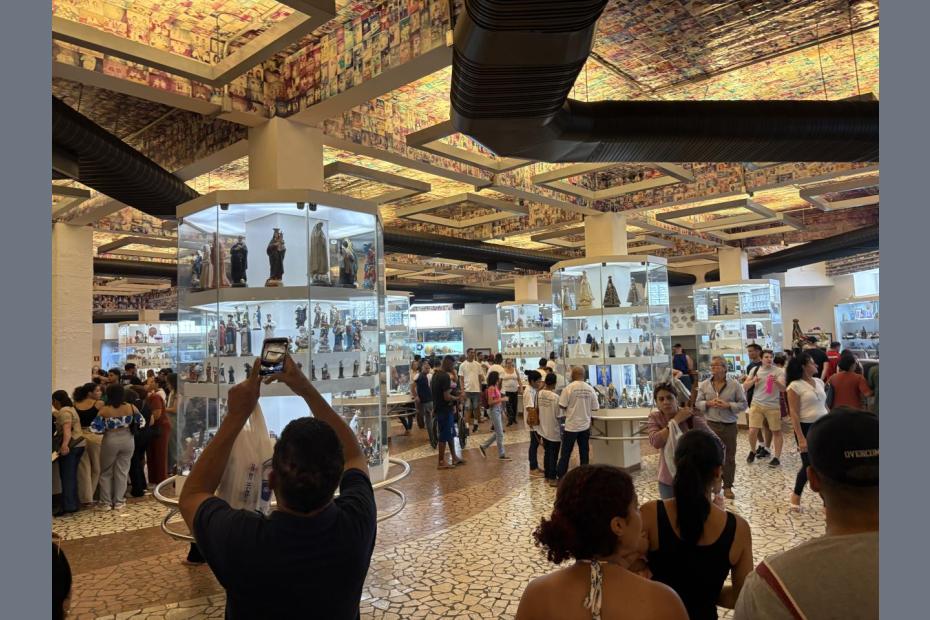 A huge room below the basilica serves as a highly curated, museum-like place to see ex-votos--objects and photos offered to the shrine as a tangible sign of hope or thanksgiving, usually for a particular family member in need.
 -
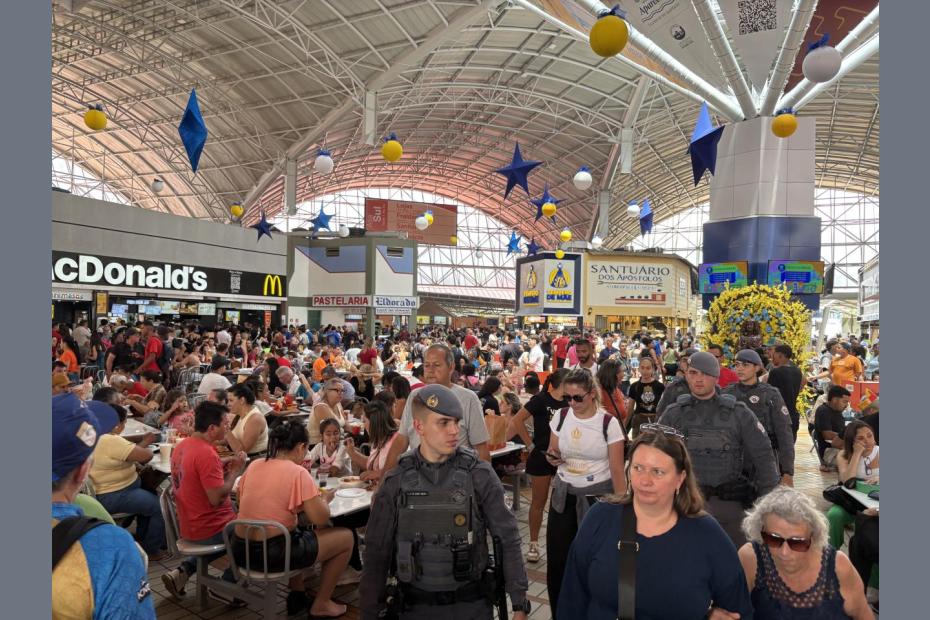 The shrine has an enormous food court nearby to feed visitors. Perhaps more than any other shrine in the world, this one has been designed with an eye to the design and organization of a contemporary mall.
 -
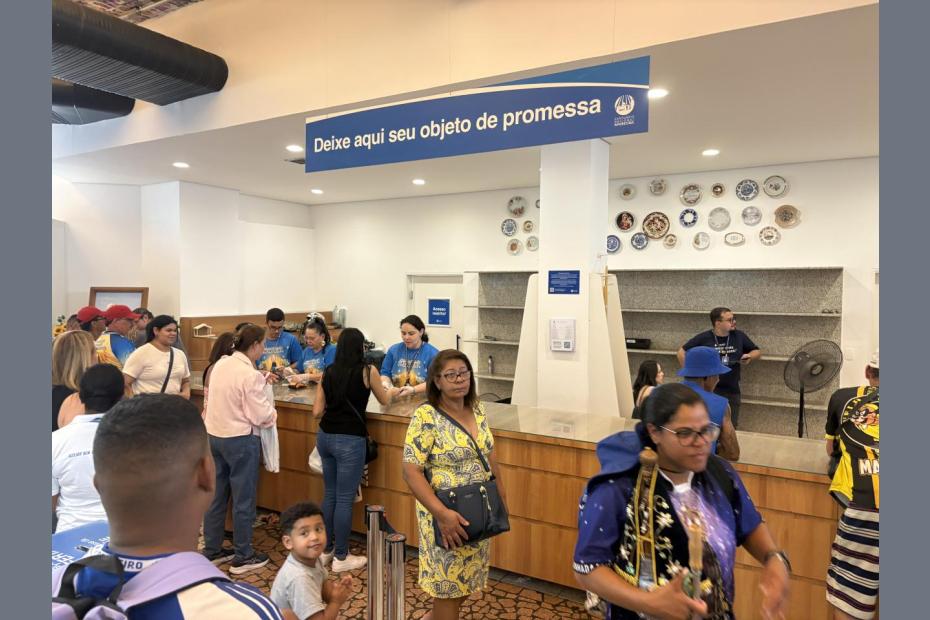 A desk for leaving ex-votos, objects brought to the shrine to manifest a prayer sought or in fulfillment of a promise to return see Our Lady.
 -
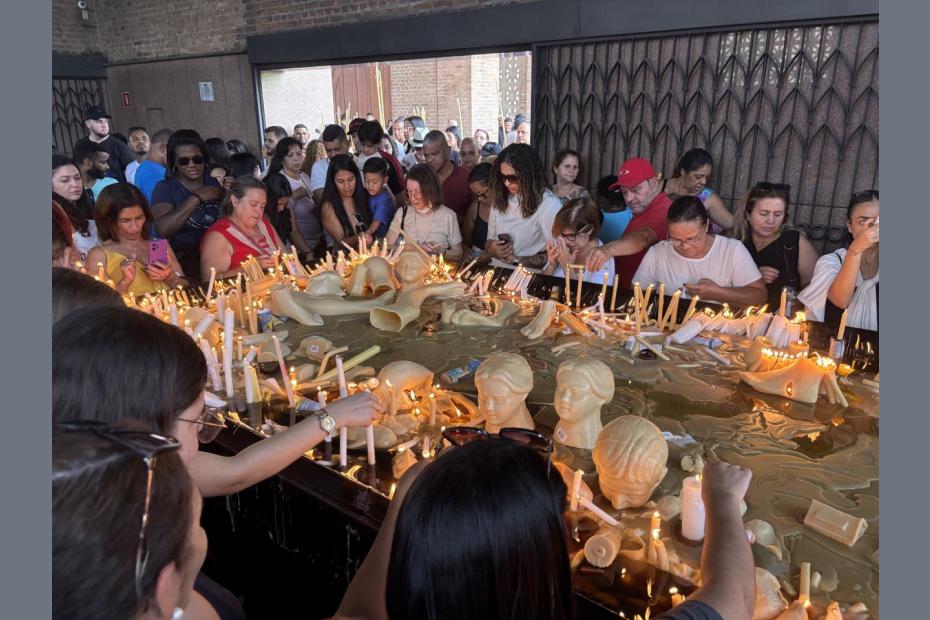 Some candles that are burned are shaped like the person being prayed for or the body part in need of healing.
 -
-
-
Pilgrims hoping to visit the largest Marian shrine in the world might be surprised to learn that that aspiration would direct them not to Lourdes or Fátima, but instead to Brazil, to a small city halfway between São Paolo and Rio de Janeiro, to the shrine of Nossa Senhora Aparecida, Our Lady Aparecida.1 By volume and seating capacity, the shrine of Our Lady Aparecida is the second-largest church in the world, only slightly smaller than St. Peter’s in Rome. In 2025, 10.5 million visitors are said to have visited the shrine, far more than visited the two world-famous shrines in Europe.2
Even as the proportion of Catholics in Brazil has dropped precipitously, from 92 percent in 1970 to 56.8 percent in 2022, the number of visitors to this shrine has continued to grow, turning a village on the outskirts of the city into a hotel-filled small city in its own right. The account that follows describes participation in the 2025 celebration of the feast of Our Lady Aparecida at the shrine.3
The Image
The image that draws so many devotees to the shrine is a small (~36 cm), brown, clay statue of the Virgin Mary wearing a gold imperial crown and an embroidered, deep blue, nearly black mantle that typically has a small Brazilian or Vatican flag pinned near the bottom.
Aparecida means “appeared” in Portuguese, but the name does not refer to the kind of apparitions claimed at Lourdes or Fatima, apparitions of a person that were subsequently memorialized by statues. This “appearance” refers to what might normally be recounted as a tale of some fishermen finding a statue, but to the faithful is a story of Mary revealing herself on the outskirts of Guaratinguetá to the fishermen and the world by means of the statue’s appearance.4 Unlike Lourdes and Fatima, no recorded words or messages accompanied the appearance. The story is that in 1717, three men fishing in the Paraíba do Sul river brought up the small brown clay statue of the Virgin Mary in their nets. (The mantle and crown were added later.) Devotees regard the statue’s “appearance” in the nets as a miracle in itself, a gift and a sign from God.
Devotees who visited the shrine on the feast repeatedly stressed that for them, the location of the appearance is important, and brings with it national significance: she came to and for Brazil. “It’s not just for us,” that she appeared here, a woman named Vitória from a nearby town reported. ”It’s for the whole of Brazil.” For many Brazilians, Aparecida’s brown appearance helps signal that she is one with them.5
The Shrine
While the shrine draws visitors from other countries, patronage at the shrine is overwhelmingly Brazilian. Nossa Senhora Aparecida was designated by the Church as the Patroness of Brazil in 1930. In 1980, the government similarly declared her Patroness of Brazil and made her feast day, Oct. 12, a national holiday.
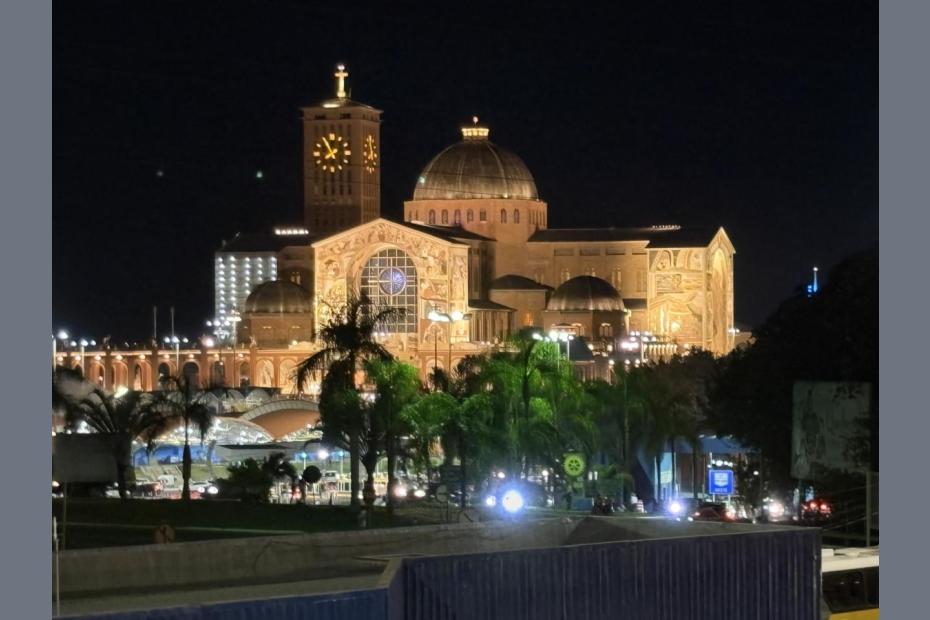
In 1928, following an increase in religious pilgrimage, the area of Guaratinguetá where the statue was discovered was renamed Aparecida and made a separate municipality. In 1955, work began on an enormous “national sanctuary” complex that supplanted the 19th-century basilica church in Guaratinguetá. The new basilica, consecrated in 1980, has almost 72,000 square meters of floor space. Popes John Paul II, Benedict, and Francis all visited it during their papacies. Francis had been there before, as a cardinal, leading an important continent-wide bishops’ meeting, and had a particular devotion to her.
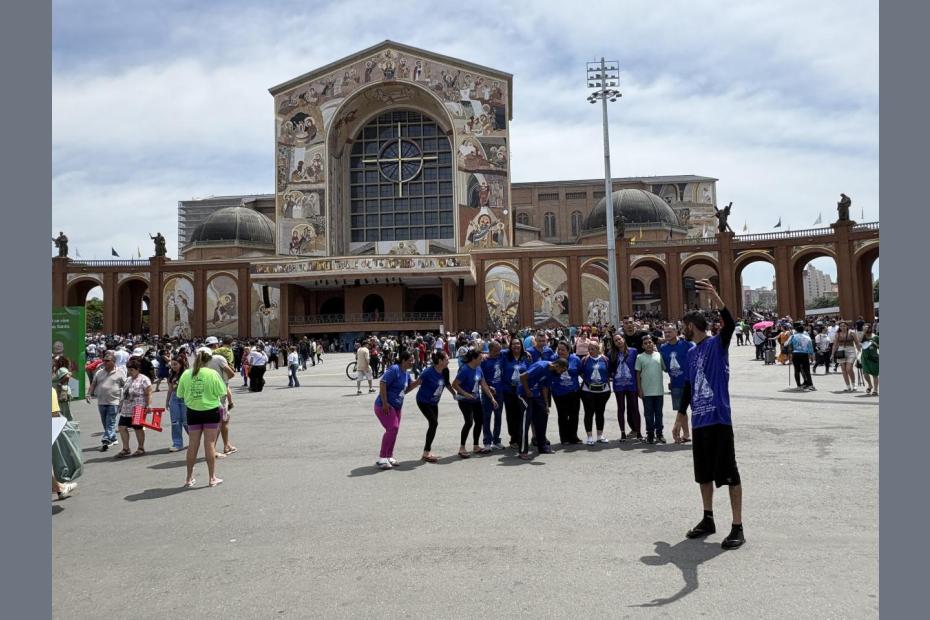
Since 2021, the exterior, once designed in plain brick in homage to the fact that the image of Aperecida was made of local clay, has been extensively covered with a series of vibrant mosaics portraying stories from the bible. The mosaics, designed by the Centro Aletti in Rome, have continued to be installed despite multiple abuse allegations against the Center’s founder/director, Fr. Marco Rupnik.
Near the altar at the center of the basilica, a copy of the statue is on display for all to visit. All around it, one sees pilgrims stopping to visit, often with cell phones held up for what look like extended selfies. As one pilgrim explained, what appear to be selfies are often video calls to family who were unable to attend, so that they can see the image and pray together with the in-person pilgrims.
The original image of Aparecida is housed in a dedicated side chapel, where it is vividly surrounded by a contemporary gold background. This is often the first stop for pilgrims, who wait in line at a special entrance for a chance to stand before it. The image was shattered during an attack and theft in 1978, but has been rebuilt.
In another area at the edge of the church, a high, partially open-air room is ablaze with candles. One popular tradition is to purchase candles as tall as the person being prayed for. So many of these line the edges of the chapel that the heat is quite intense as they burn. Long tables in two spots hold smaller candles and wax figures shaped like parts of the body in need of healing.
Downstairs, a series of rooms is devoted to collecting and managing the huge number of ex-votos left behind as offerings in thanksgiving for favors received, or as symbols of a prayer need, or simply to foster a relationship with Our Lady. The steady flow of objects seems to be lovingly received by volunteers and then brought into a back room. Whereas many shrines contain a somewhat hodge-podge assembly of ex-votos as left by pilgrims, these are carefully managed and curated. A small selection of them is displayed in various glass cases. Elsewhere, there are small displays that serve as sites for selfies and stations for young children.
Outside, the shrine has parking for 2000 buses and 3000 cars. The largest feature is an enormous mall-like food court and souvenir shop pavilion, and visitors can also find a cable car, a convention center, and even a carnival on the peripheries. The shrine operates two high-rise hotels, and there are more than 50 hotels close by, with more under construction. The shrine also runs a radio and television station nearby.
The shrine complex is highly managed. It employs nearly 2600 people, plus volunteers and the many police who direct traffic.6 Outside of the basilica itself, and even in its lower areas, the experience seems controlled and organized in a way most reminiscent of a well-organized shopping mall where nothing is accidental or out of place. Unlike many other shrines and festivals, one does not find local poor people peddling rosaries, candles, or food. Everything is managed and official.
Pilgrims at the Feast
The nine days leading up to the feast are marked at the sanctuary by five masses and two novenas daily. Over the course of those days, and on the feast itself, the shrine’s Redemptorist organizers counted just shy of 500,000 pilgrims.7 Along the major roads to the shrine, countless pilgrims–some indicated in interviews that they had been walking for all nine days of the novena–walked on the side of the road from several directions. The highway from Saõ Paolo, for example, was lined regularly with tents and smaller stands where walking pilgrims could rest, get a free meal or drink, get a leg massage or bandages for blisters, or even sleep overnight safely. The tents, coordinated for continuous spacing, were staffed by volunteers, families, and businesses who saw their work as an act of devotion to Our Lady. Three pilgrims who walked 95 km with a parish group of 85 people–one for the seventeenth time, one for the seventh, and one for the first–reported that they slept at “a gas station, on the sidewalk, wherever there was space, we slept.” “My foot is destroyed,” one woman in the group showed us, laughing. “It requires a lot of psychological, physical [determination]. Then you want to give up. You see a lot of people along the way worse than you. Better than you. But you have to have a purpose.” The shrine is prepared to receive them. When they arrive, they can access first aid, massages, and more to care for blistered feet, painful muscles, and other basic maladies from their trip. For more serious issues, the shrine has its own infirmary and ambulances.
By the eve of the feast, the massive parking lots were already full of buses. On the morning of the feast, parking was full by 9 am and stayed full well into the afternoon.
One reason why attendance at the shrine has grown even as many Brazilians have turned to Evangelical churches or to no affiliation at all was evident from the first interviews of pilgrims on the feast: a surprising number of pilgrims in that informal sample turned out to be Evangelicals. Evangelical church leaders have famously rejected devotion to Our Lady Aparecida–one tried to steal it and broke it into pieces; another famously smashed a copy on television–yet a surprising number of Evangelicals came on the feast day with Catholic friends. One had even walked 76 km to get there, in a group comprised of both Catholics and Evangelicals.
Mutual Support, Promesas, and a Mother who is both close and powerful
Pilgrims described themselves as having come to support one another, coming to find peace. Usually, the visit had a social component: they walked with someone who encouraged them to do so, or came at the encouragement of a family member. One man started coming after his first child was born, at the encouragement of his grandmother. Without specifying more, he said that he brought a photo of his father with him and left it there. It was evident at the ex-voto counter that many people brought some physical object with them that symbolized some concern or loved one.
An Evangelical man said that what he thought people “brought” most of all was their struggles. He saw something he regarded as authentic here when he noted the tears and the struggle that were manifest in the faces of many people who came before Aparecida. A Catholic woman who was there for four days and had come for 20 years with her family said, “I have requests, but I always come to thank.”8 Her husband chimed in, “Thanks for the day-to-day, our work, health, you know?” Another man came because he had a serious case of anemia, asked for help, and was cured.
The image of Aperecida, in a mantle that hides much of her physicality and an imperial crown that sets her far above the lives of the people who travel here, could seem remote. Her title, “Our Lady,” could suggest the same. In addition to that noble, distant title, though, shrine brochures and interviewees also referred to her as Mãe Aparecida, Mother Appeared. Interviews suggest that she is understood in a both/and way as powerful and as loving/intimate. Asked to describe what she is like, one man described her as "powerful and welcoming. She is our intercessor. When we want to ask Jesus for something, we tell her and she walks our request to him, makes a bridge to Jesus.” Another man, Daniel, described being in the presence of the image as “very powerful. There are no words to describe it.” Asked the same question, a third man said, “Aparecida is a mother. When we need a favor, when we have a problem, anything, we go to our mother. First of all. And we can trust her.” Another couple described her this way, filling in for each other: “She is your mother. The love you have for your mother is her. She is just like your mother. That's it. She is strong, she is gentle, affectionate, welcoming. She is everything, right? She protects, she is everything.”
As is true in many other Iberian-influenced places, many devotees visit or walk to make or fulfill a promesa, a commitment to carry out a particular act, such as traveling to a shrine, for a certain number of years. Often accompanied by a prayer request, a promesa is usually regarded by devotees not as an act of exchange, but as a way of building up a relationship with whoever it is offered to, such as Our Lady Aparecida.
When asked whether it constituted a deal to come here as part of a promesa, one man answered, “We love Our Lady, and we ask for her intercession. We ask her to help us… But maybe the will of God is not ours. We have to understand this.” He was aware that one might ask, but not receive what was asked for.
A woman reported that her promesa lasted seven years. “I had a very turbulent divorce. So I asked Our Lady to help me solve this situation. So many things happened. Thank God, in the end, everything worked out. So I made a seven-year promise. And this was the last year of my promise. I have faith.”
A man and his wife said that they had been coming here through the whole novena for a decade, to make a retreat. They said that they come every year not to make a request, but as an act of devotion, since “God has given us many graces.”
Maria, who came regularly to the feast as part of a promesa, offered that she had brought pictures of her sisters, and that her mother had suffered a heart attack this year, but that she came solely as a means of thanksgiving. Ultimately, carrying the pictures and walking and being with others was about presence, and not only about presence with them: “During the journey, you have the various sensations of the presence of Our Lady on our path. It's not a sacrifice you're offering. On the contrary. We feel it when we come here. It's a joy. It's a joy. People who first come here suffer a lot because it's exhausting. But after two years, you come here praying, talking, reflecting on what happened in your life. It's a reflection. It's you and her. But it's not a sacrifice. It's not that you're offering a sacrifice in exchange for a benefit. It's not a bargain.”
- 1In English, she is sometimes called Our Lady of Aparecida, Marya mistranslation of the Portuguese, Nossa Senhora Aparecida. As explained below, the title refers to how she was found (her statue appeared in fishermen’s nets), not to a place name where she was found. Given that the place where she was found has since been renamed Aparecida, the use of the word “of” can make sense, but does not reflect the still-common Portuguese usage.
- 2Assessoria de Imprensa, “Em 2025, Basílica de Aparecida aolheu 10,5 milhões de fiéis” Jan 5, 2026. Fatima claimed about 6.5 million visitors in 2025, whereas various accounts from Lourdes claim 3-6 million visitors. Estimates for the shrine of Annai Velankanni, Our Lady of Good Health[link] in India range from 5 to 20 million per year, while Mexico’s Our Lady of Guadalupe shrine[link] claims as many as 20 million visitors a year.
- 3Particular thanks are due to Eduardo Campos Lima, who accompanied me to the shrine with his wife Andrea and young son, Pepe, functioning in turns as a journalist, a translator and a devotee of Nossa Senhora Aparecida, in thanks for his own recovery after an illness.
- 4The primary account says that they first brought up the body of the statue in their nets, and then the head. This form of appearance has numerous parallels in other important Marian devotions in the Iberian world. Examples include the Virgin of Arantzazu, the patroness of the Basque region in Spain, whose statue was found in a hawthorne tree; the Virgin of Rocío, from Andalusia, Spain, found hidden in a tree; Our Lady of Montserrat, in Catalonia, Spain, found in a cave; Santa Marian Kamalen, from Guam, found floating in the ocean; the Virgen de la Caridad del Cobre, patron saint of Cuba, found floating in the sea; and Reinha Rosari, found on the beach in Flores, Indonesia, at the dawn of Portuguese influence there. In India, the Dhori Mata, found in a coal mine, is a more modern version of the phenomenon from a non-Iberian context.
- 5Though the color of the image is explained away in many accounts, Our Lady of Aperecida is one of a number of black or brown images in the Catholic world, including Our Lady Of Montserrat and Our Lady of Guadalupe in Spain, Our Lady of Guadalupe in Mexico, among the most famous. There are also hundreds of black Madonna images throughout Europe in countries that at the time the images were made had no significant Black populations. It was notable to see that in some shops selling replicas, it was possible to instead purchase a pure white image of Aparecida.
- 6The shrine even claims to have 1000 toilets for pilgrims. Jornal Santuário, ano 124, no. 5.900, October 2025, 4.
- 7Assessoria de Imprensa, “Em 2025, Basílica de Aparecida acolheu 10,5 milhões de fiéis” Jan 5, 2026.
- 8Unless otherwise identified interviewees quoted here are Catholic, given that the purpose of the initiative is to understand Catholics and their practice.